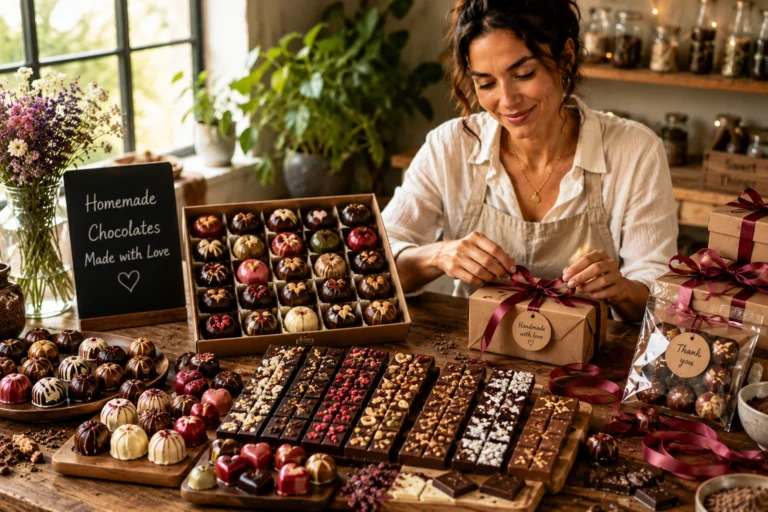

Somewhere between admiring someone else’s beautifully wrapped gift basket and actually building your own, most women assume this is either a cute hobby or a business only for people who already have design training. Neither is true. A home gift basket business is one of the most realistic ways to turn genuine creative instinct into real income, and it’s been done from spare bedrooms, basements, and kitchen tables for decades, not just on Instagram in the last few years.
This isn’t a vague overview of “start a gift basket business.” It’s the actual mechanics: how to choose a niche specific enough to stand out, the real techniques behind assembling a basket that looks professionally styled instead of thrown together, the packaging method that separates a homemade look from a commercial one, honest pricing formulas instead of guessing, and the specific marketing channels, including one B2B relationship almost nobody starting out thinks to try, that actually generate consistent orders.
A home gift basket business works by combining a specific, ownable niche, a repeatable assembly and packaging method, and honest cost-based pricing, then selling through a mix of local marketplaces, social platforms, and direct outreach to businesses that buy gifts repeatedly, rather than waiting for one-off individual holiday orders alone.
Why This Business Genuinely Works From Home
Curating and assembling gift baskets is a genuinely old practice dressed up in new packaging. What’s changed isn’t the core idea, it’s how accessible the tools and sourcing have become. A spare room, a folding table, and a consistent source of non-perishable gourmet goods and decorative packaging materials are enough to start, no commercial kitchen, no storefront, no inventory warehouse required.
The honest range of what this earns varies enormously and depends almost entirely on volume, niche, and whether you’re selling one-off individual orders or building repeat business clients. Small home-based sellers typically bring in a modest supplemental income working a few orders a month, while sellers who build a genuine B2B pipeline with local businesses can grow this into a much larger, more consistent revenue stream over time. There’s no single honest number to promise here, and any article that hands you one specific income figure for this business isn’t being straight with you.
Choosing a Niche Specific Enough to Actually Stand Out
The single biggest mistake beginners make in this business is offering a generic “gift basket for any occasion” instead of an ownable, specific theme. A generic basket competes on price against every other generic basket. A specific one competes on almost nothing, because there’s no easy comparison to make.
Strong niche directions include baby gift boxes built around genuinely useful newborn items rather than generic baby products, gourmet coffee or tea assortments paired with a specific regional or artisanal sourcing story, spa and self-care hampers built around a consistent scent and material theme, sympathy and comfort baskets designed specifically for hard moments rather than celebrations, and internationally-themed snack boxes built around a specific country or region’s specialty foods.
Real estate closing gifts and corporate appreciation baskets, covered in more detail in the marketing section below, are their own strong niche entirely, built around a business buyer rather than an individual one. If you’re still deciding on a niche generally, it’s worth browsing other home-based business ideas built around a specific skill or interest for inspiration on how narrow and specific a winning niche actually needs to be.
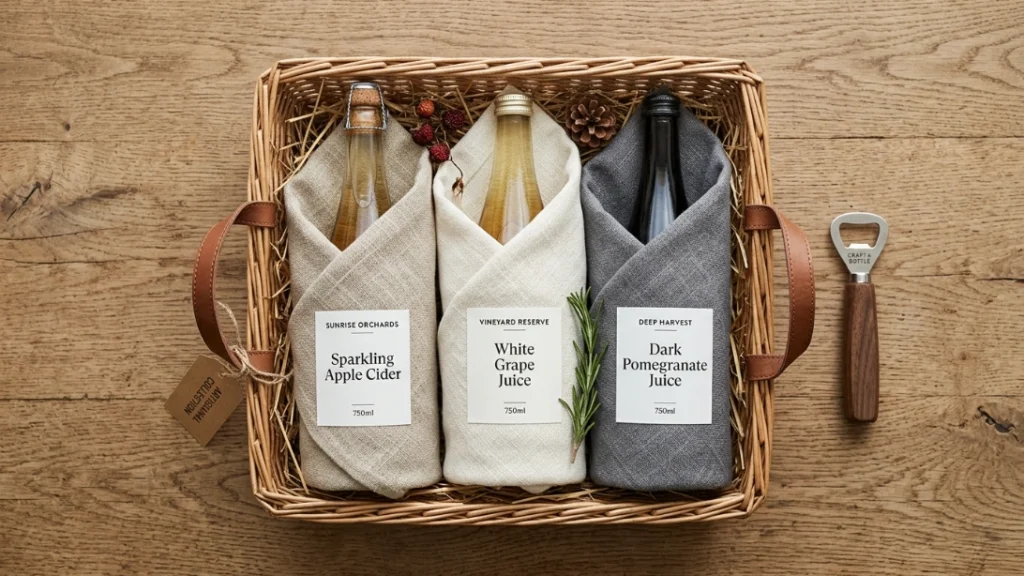
Wine and spirits gift baskets deserve their own specific approach, since design mistakes here are more visible than in almost any other category. A basket built around three bottles, one sparkling, one white, one red, reads as intentional and complete in a way a single random bottle doesn’t.
Choosing bottles with some kind of story behind them, a specific region, a smaller producer, rather than the most recognizable supermarket label, elevates the entire piece without necessarily raising the cost much. Stick to widely appreciated, familiar varietals unless you know the recipient’s specific taste, since an unusual or polarizing bottle is a real risk in a gift nobody asked for by name.
Skip fragile stemmed glassware entirely, since breakage during shipping or transport is one of the fastest ways to turn a beautiful gift into a customer service problem, and skip gimmicky bottle openers in favor of one genuinely well-made wine key. Choose bottles that are ready to drink now rather than ones meant for long-term aging, since the entire point of a gift basket is immediate enjoyment, not a future project.
Sourcing Non-Perishables Without Losing a Weekend to Errands
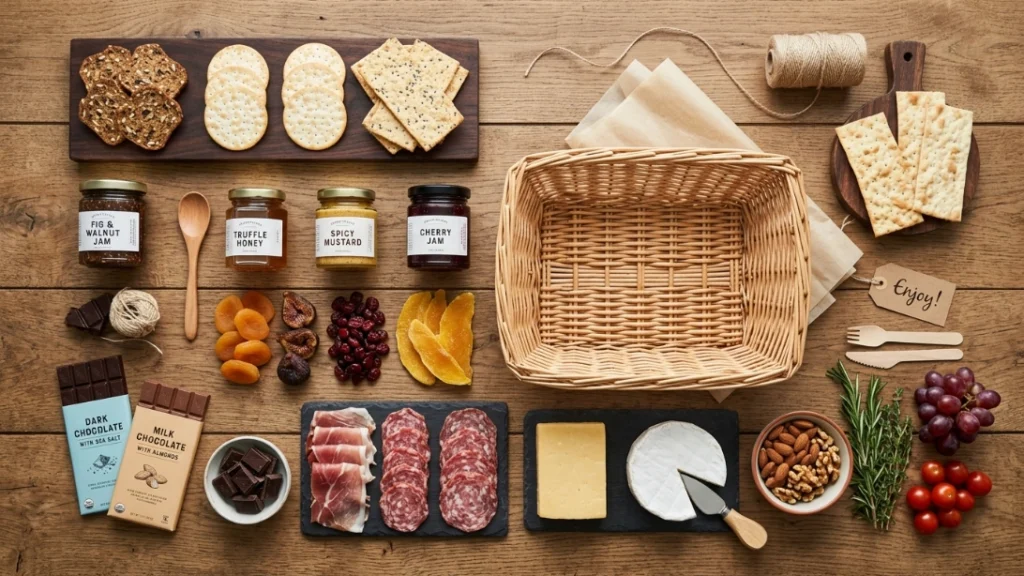
Charcuterie-style gourmet food baskets, crackers, spreads, jams, specialty snacks, remain one of the most consistently popular categories in this space, and building them around shelf-stable, non-perishable ingredients protects your margins in a very specific way: nothing in inventory can spoil, freeze, or melt while waiting to be assembled or shipped.
A strong charcuterie-style basket typically includes a sturdy, flat item like crackers or breadsticks as the structural backbone, a few specialty spreads or jams in glass jars for visual variety and flavor, a savory element like marinated olives or artichokes, and a sweet finishing touch like specialty chocolate or brittle that won’t melt at room temperature. Building this list once and sourcing consistently from it, rather than reinventing the product mix for every single order, is what actually makes repeatable production manageable for one person working from home.
The real time and money leak in sourcing isn’t the ingredients themselves, it’s driving between multiple stores hunting for individual items. Picking one or two reliable sources and building your product mix around what’s consistently available there saves real hours and real gas money over dozens of orders.
Choosing Packaging That Reads as Professional, Not Homemade
The base container shapes the perceived value of the entire basket before a single item is placed inside it. Cheap plastic baskets and excess styrofoam read as low-effort immediately, while sustainable, reusable containers do double duty, they hold your product and remain genuinely useful to the recipient afterward.
Strong base options include classic picnic-style wicker baskets, keepsake woven totes the recipient can reuse for storage, and flat charger plates, inexpensive, widely available, and genuinely versatile for stacking items of different shapes and sizes into a clean, front-facing display.
The Full Process: How to Actually Build and Decorate a Basket, Step by Step
Pulling every technique together into one sequence makes this far less intimidating than treating each piece as a separate skill to master. Here’s the real order of operations, from empty base to finished, photo-ready piece.
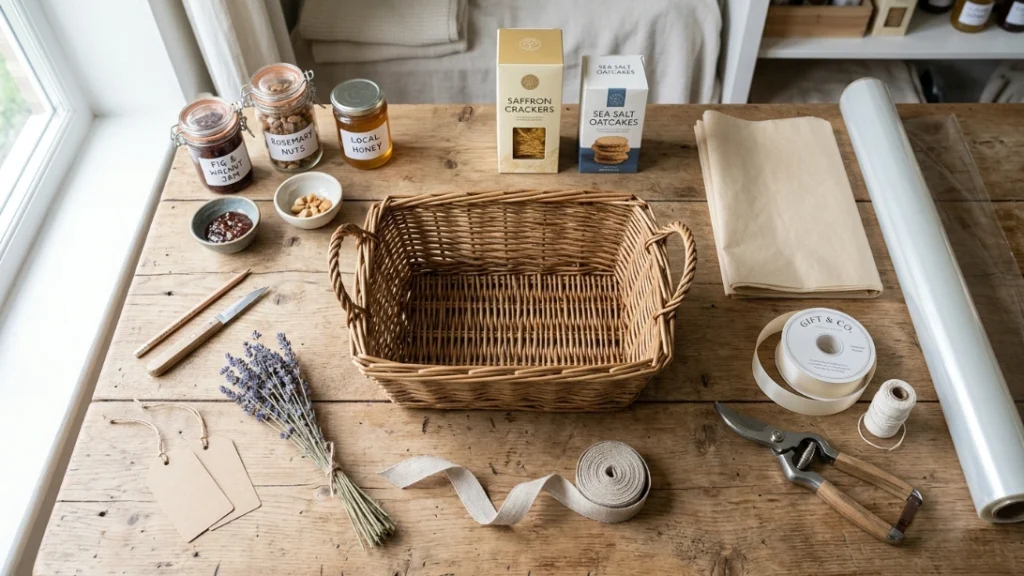
Step 1: Prep your base and stage every item first. Lay out everything you’re using, base, filler, every product, ribbon, and accents, on your work table before placing a single thing into the basket. Assembling blind, reaching for items as you go, is how baskets end up lopsided or short an item halfway through.
Step 2: Build the structural grid. Anchor your flat, sturdy item in the center, build your tallest pieces at the back, and work outward with matching weights on each side, exactly as covered in the layout section above. This is the skeleton everything else attaches to, so it has to be right before you move on to decoration.
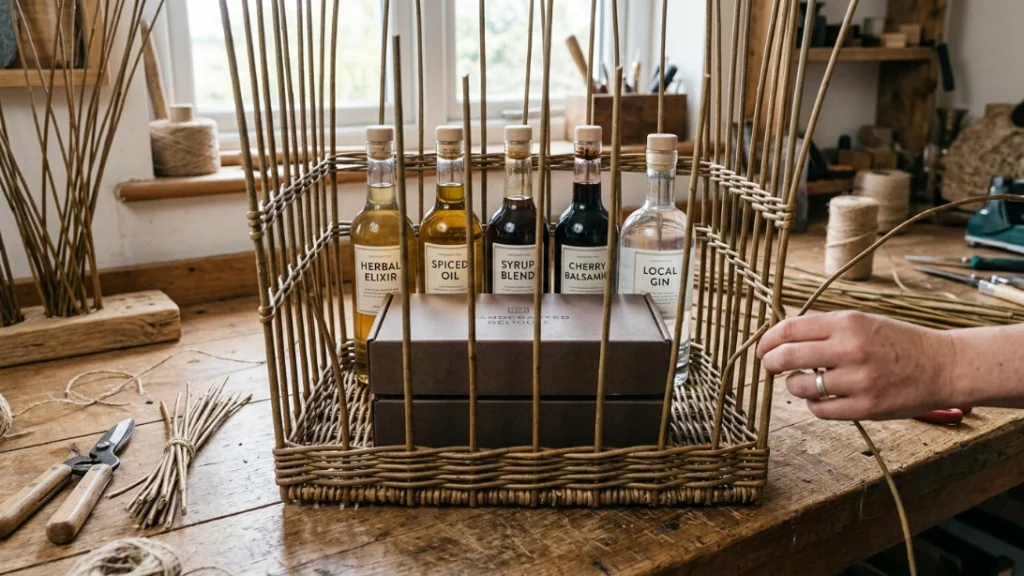
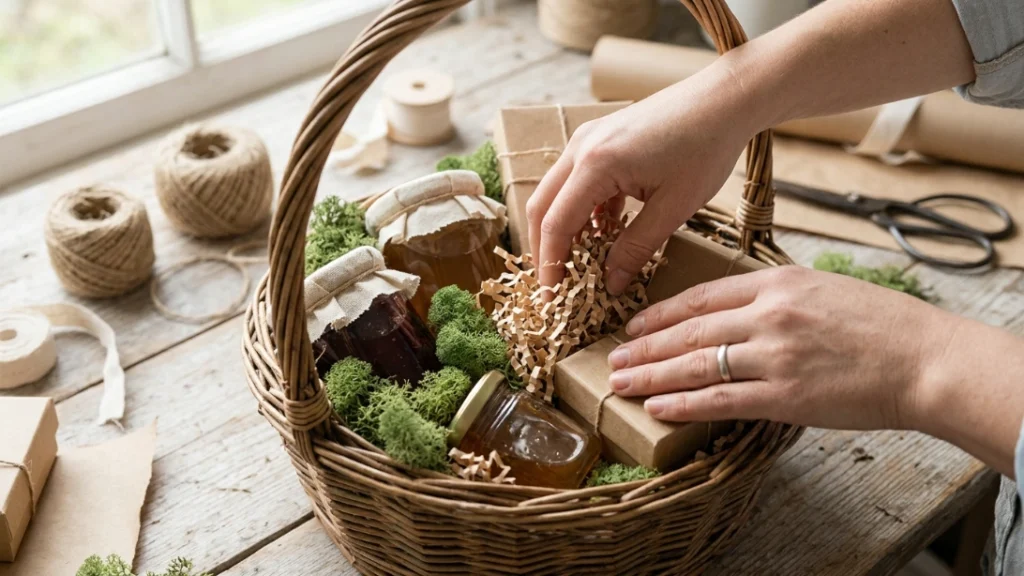
Step 3: Add filler before anything decorative. Natural moss, crinkle paper, or shredded natural fiber goes into gaps first, both to cushion items and to give any flowers or loose decorative pieces something to nestle into rather than sitting loosely on top.
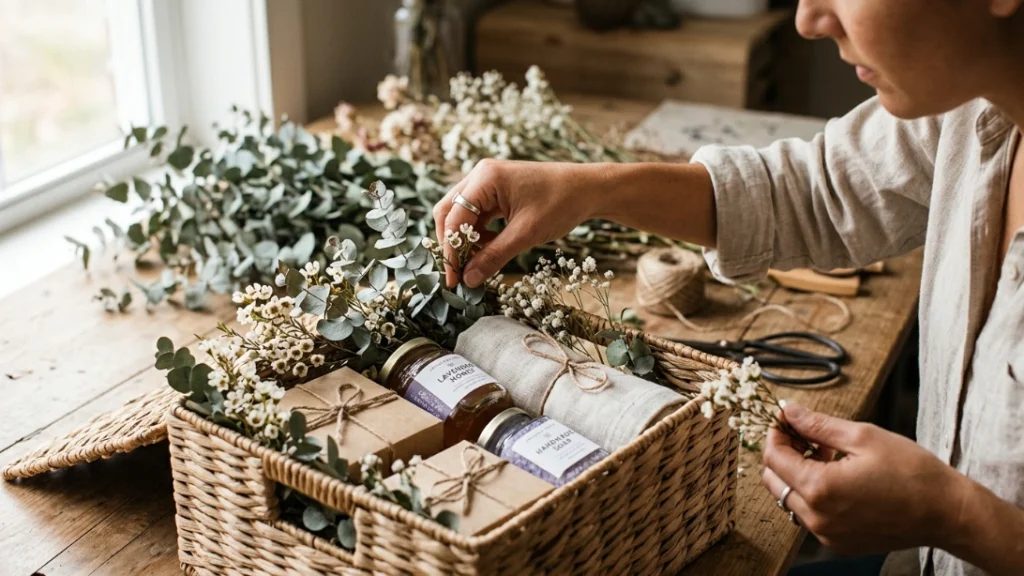
Step 4: Add flowers, if you’re using them, last among the “structural” elements. Fresh flowers should be added as close to delivery time as possible, ideally the same day, since they wilt fastest and a basket built a day early with fresh florals already tucked in will look tired by the time it arrives.
A small floral pick or water tube keeps a single stem hydrated for a day or two if you need to build slightly ahead. Artificial or dried florals are far more forgiving and can be added at any stage, and they’re the better choice for anything shipped rather than hand-delivered locally, since fresh stems rarely survive transit well. Place flowers at the back or sides as a soft frame around the taller items, never directly in the front row, where they’d block the products you actually want visible.
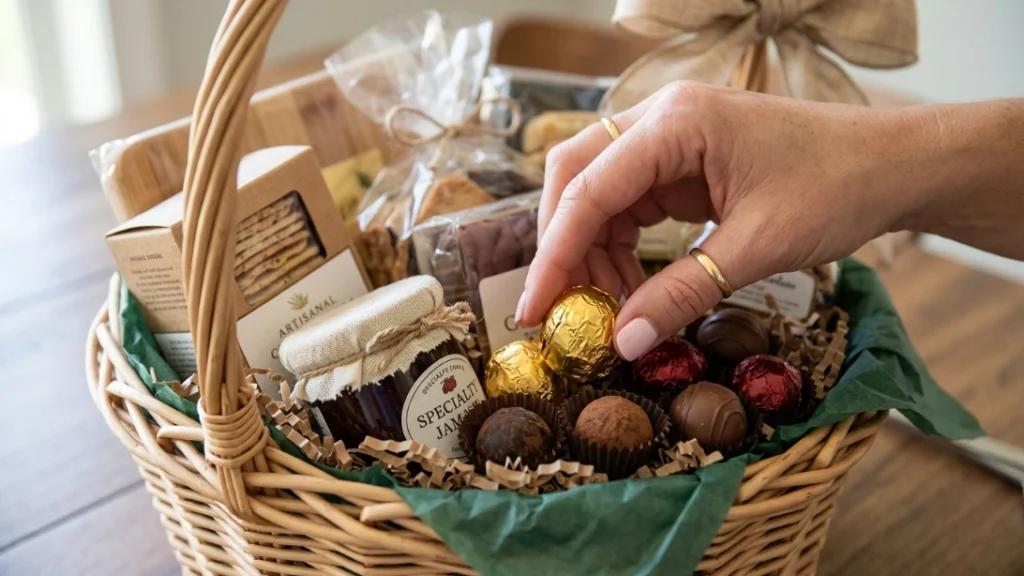
Step 5: Add chocolates and candies as both filler and finishing detail. Individually wrapped chocolates or hard candies are the easiest decorative filler in the entire process, they tuck into any remaining small gaps, add color, and eliminate empty visual space without needing any special technique.
For a more styled, dimensional look, some sellers attach a few pieces directly to the outside of the basket or the ribbon itself using a small dot of food-safe hot glue on the wrapper only, never touching the actual candy, which creates a decorative accent that doesn’t get lost among the other items. A small skewer or floral pick pushed through a wrapped candy and tucked upright among taller items adds height and visual interest in exactly the spots that otherwise look flat.
Step 6: Do a final visual check from the front only. Step back and look at the basket exactly the way a customer would first see it, straight on, not from above. This is the moment to notice and fix any gaps, leaning items, or visible filler that should be covered, before moving to the final wrap.
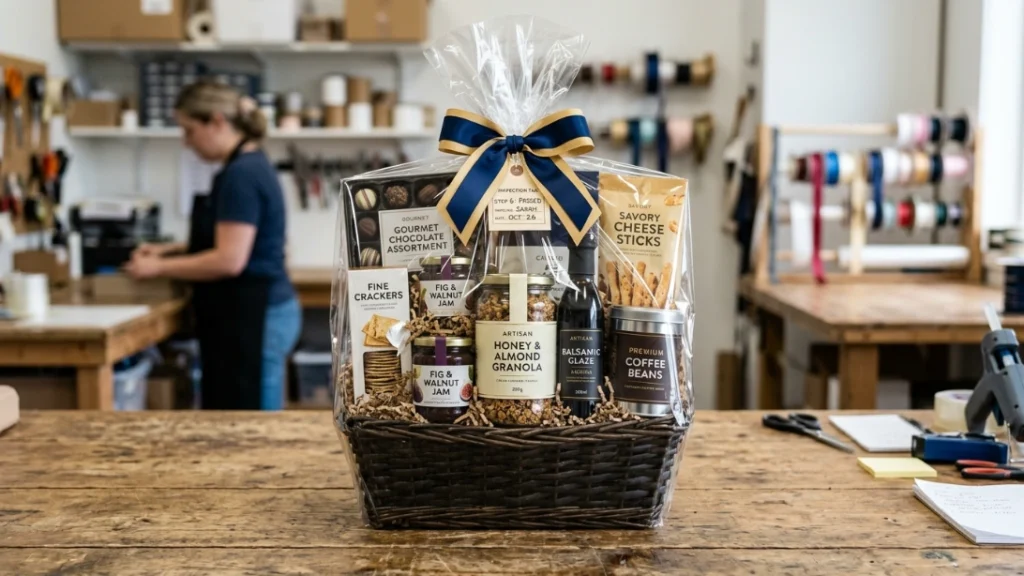
Step 7: Shrink wrap and finish with the bow and accent, exactly as covered in the packaging finish section, gathering the top, sealing with continuous heat sweeps, and covering the elastic band with a full, fluffed bow and any seasonal accent piece.
Treat your first two or three baskets as practice runs specifically for this sequence, not finished products to sell immediately. The difference between a basket that looks intentional and one that looks assembled in a hurry is almost entirely in steps 4 through 6, the decorative layer and the final check, which are exactly the steps beginners tend to rush past to get to the satisfying part of wrapping it up.
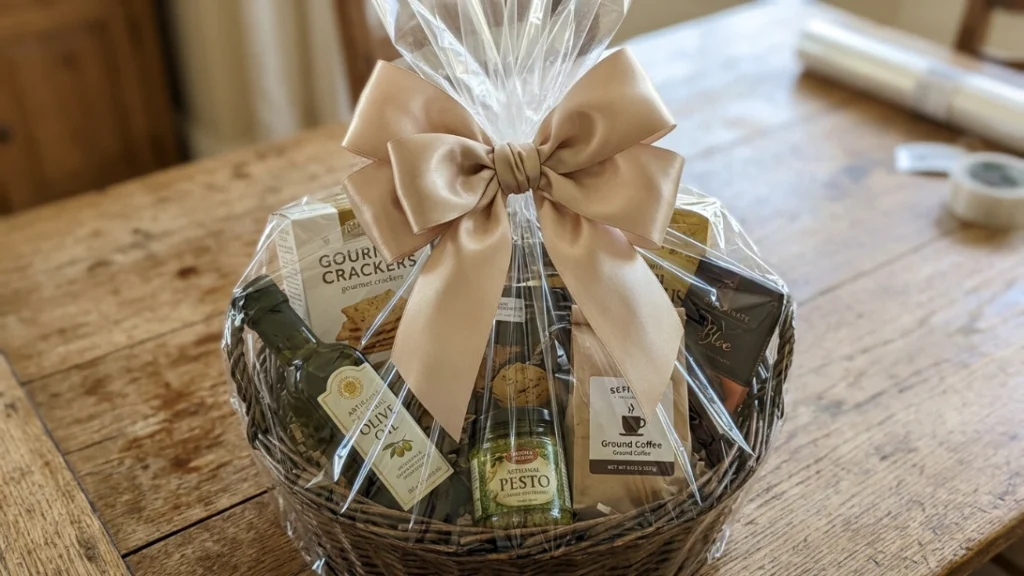
The Structural Grid Layout: Building a Basket That Looks Intentional
Assembling a basket that looks professionally styled rather than randomly stacked comes down to a specific, repeatable layout method rather than instinct alone. Start with a sturdy, flat item anchored in the center of your base, this becomes the visual foundation everything else builds around. Place your tallest, most rigid items directly behind that center anchor, creating a clean vertical backdrop.
Build outward from the center with items of roughly matching size and weight placed on opposite sides, which is what actually creates the sense of balance a customer notices even if they couldn’t explain why it looks put-together. Fill the middle layer with your jars and mid-sized items, and reserve your smallest, most colorful pieces for the very front, where they draw the eye first. Any remaining small gaps get filled with tiny individually wrapped pieces, both to eliminate empty visual space and to keep everything from shifting during transport.
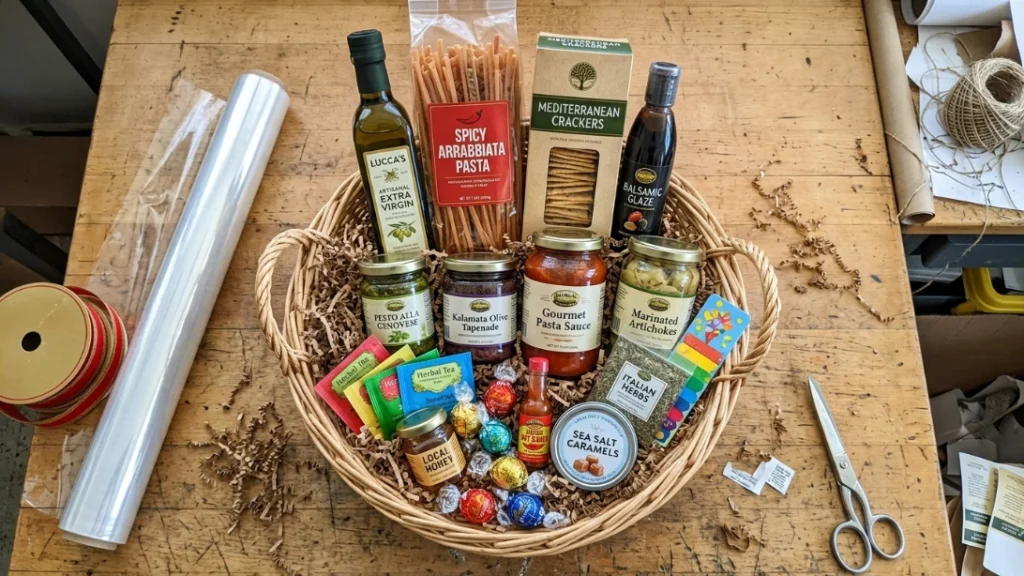
Cushioning matters as much as the layout itself, particularly for anything glass. Wrapping bottles or jars in a soft textile, a linen towel, a small tote bag, a cozy pair of socks, protects them during transport while adding a second usable item to the gift. Natural moss works well as a filler for gaps that don’t need a cushioning function specifically, adding texture and an organic, premium feel without any plastic waste.
The Packaging Finish That Actually Separates Homemade From Commercial
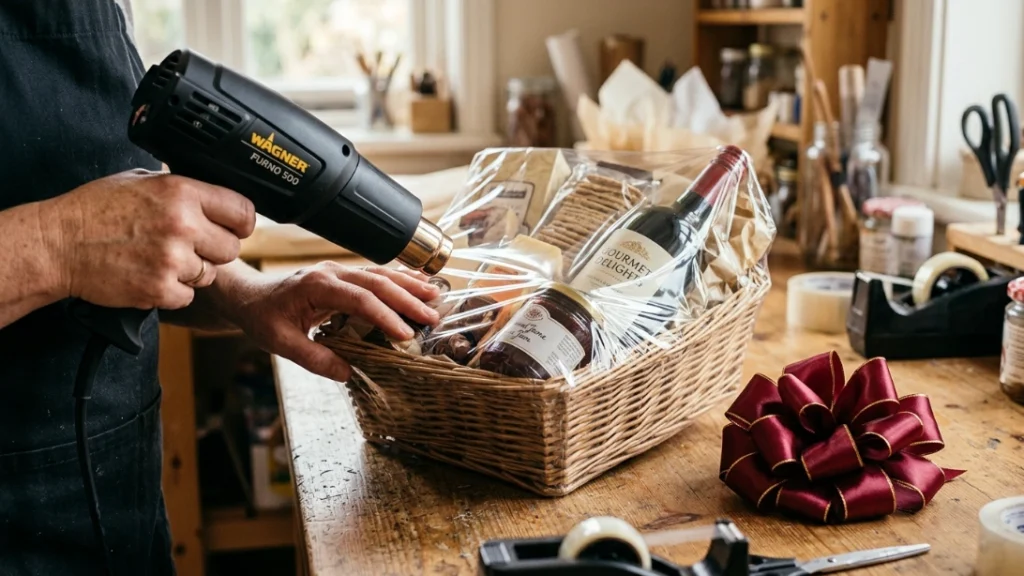
The single biggest visual difference between a basket that reads as a polished, purchasable product and one that reads as a well-meaning gift assembled at home is the final wrap. A proper clear shrink-wrap finish, pulled tight, heat-sealed, and gathered cleanly at the top, is what retail and commercial gift companies use, and it’s a genuinely learnable skill rather than specialized equipment only professionals have access to.
The basic method: choose a shrink bag sized generously for your finished basket, position your assembled piece inside it, and pull the plastic up and gather it at the top rather than trying to seal it loosely. Secure that gathered top temporarily with a simple elastic band before applying heat, which frees both hands for the next step.
Using a heat gun or a high-powered hair dryer, sweep the heat across the plastic in continuous up-and-down motions rather than holding it in one spot, working from the front face first. Holding heat in a single spot risks melting the plastic itself or damaging heat-sensitive items inside, like chocolate, so continuous motion matters more than speed.
Once the front and sides are tight and clear, sweep heat under the base to seal the bottom cleanly, then finish by covering that gathered top with a full, properly fluffed ribbon bow, which hides the elastic band entirely. A small seasonal accent, dried florals, a small ornament for a holiday basket, threaded through the ribbon adds a finishing detail that costs very little but reads as considered.
Getting the Legal Basics Right Before You Sell Anything
Before taking money for a single basket, a few real legal steps protect you and the business itself. Most home-based sellers start as a sole proprietorship by default, since it requires no separate registration, though it also means no separation between personal and business liability. Forming an LLC creates that separation and is worth considering once you’re taking consistent orders.
The IRS requires an Employer Identification Number for most business structures beyond a basic sole proprietorship, which is also typically required to open a dedicated business bank account and establish credit with wholesale suppliers. The Small Business Administration outlines the general registration steps for any new small business, including checking whether your specific city or county requires a home occupation permit for a business run out of a residence.
If your baskets include alcohol, food product regulations around this vary significantly by state, and shipping alcohol across state lines carries its own separate set of rules entirely. This is genuinely worth confirming with your state’s alcohol beverage control agency directly.
I am not a financial advisor and this is not financial advice. For guidance specific to your business structure, tax obligations, or state-specific licensing requirements, talk to a qualified professional rather than relying on general information alone.
Setting Up a Workspace That Doesn’t Take Over Your Home
A dedicated, separate workspace, a spare room, a section of a basement or garage, or even a clearly defined corner with shelving, keeps inventory organized and keeps the business from slowly creeping into every room of the house. Gift basket inventory takes up real space quickly, and packaging materials, ribbon, boxes, filler, accumulate fast once you’re producing consistently.
A simple folding table is a completely reasonable starting point for an assembly station, no dedicated furniture required until volume genuinely justifies the investment.
Honest Pricing: Cost-Based Formulas That Actually Protect Your Margin
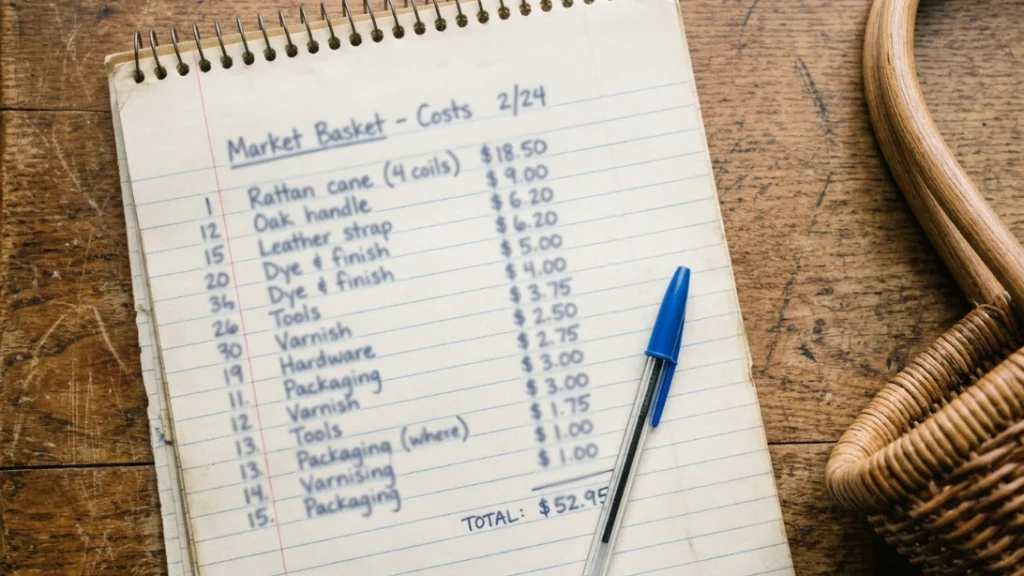
Pricing is where most beginners either undercharge out of nervousness or guess a number that feels right without actually protecting their time and materials. The starting discipline that matters more than any specific formula is this: price every single item that goes into a basket, including the small things that feel too minor to count, filler material, ribbon, the accent piece, the shrink bag itself. Skipping these small line items is exactly how a basket that looks profitable on paper ends up barely breaking even in reality.
From there, a few widely used cost-based pricing approaches give a starting framework. The simplest doubles your total material cost to set a retail price, a reasonable starting point for a casual, low-volume seller. A more sustainable approach for a genuine part-time or full-time income doubles the cost and adds an additional markup on top, often in the 30 to 50 percent range, to account for labor time and design skill, not just materials. A third, more aggressive retail-style approach rounds the total cost up and multiplies it by three or four times, which is closer to how a commercial gift retailer would price the same product.
Whichever formula you use, the underlying principle stays the same: your price needs to cover materials, your actual working time, and a genuine profit margin, not just materials with a little extra tacked on. Exact profit margins vary too widely by niche, region, and volume to state as one universal number, but the discipline of itemizing every cost before setting a price is what actually protects your margin.
Where the Real Money Is: The Business Client Nobody Starts With
Most beginners default to thinking of this business as individual gift orders, one customer, one occasion, one basket at a time. The channel that actually stabilizes income for sellers who grow this into something substantial is business-to-business orders, and one specific relationship deserves particular attention: local real estate agents and brokerages.
Real estate agents regularly need closing gifts for clients and appreciation gifts for their referral network, and they need them consistently, not just once a year. A single relationship with one agent or a small brokerage can turn into a recurring order for dozens of baskets at once around a specific closing season or a holiday appreciation push.
Approaching this relationship works best with a direct, specific pitch: a sample basket, a clear explanation of how a considered, well-presented gift reflects well on the agent giving it, and an honest volume discount structure for repeat or bulk orders. A tiered discount, or a straightforward “order this many, get one free” structure, makes a bulk commitment easy to say yes to.
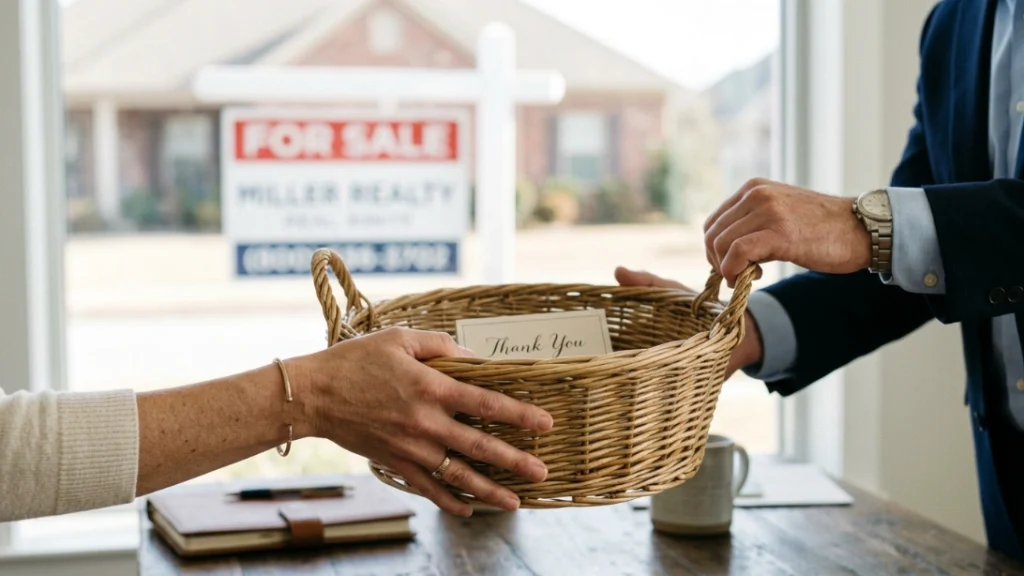
Corporate clients beyond real estate follow a similar logic: any local business that regularly gives client or employee appreciation gifts is a genuine prospect for the exact same pitch.
Free Marketing That Actually Works for a Visual Product
Gift baskets are an inherently visual product, which means the marketing that works best leans entirely on platforms built around images rather than text, and almost none of it requires a paid advertising budget to start.
Local marketplace platforms, community buy-and-sell groups, and neighborhood social apps put ready-made, photogenic baskets directly in front of local buyers actively looking for exactly this kind of last-minute or occasion-specific gift. The same photo-first listing approach that works for independent Etsy sellers starting with no upfront capital applies directly here, clear photos and honest descriptions do most of the selling before a customer ever messages you.
On broader social platforms, genuine engagement outperforms simply posting product photos and waiting. Searching hashtags relevant to your specific niche and engaging authentically with that content before ever mentioning your product builds the kind of relationship that leads to an organic recommendation rather than an ignored advertisement.
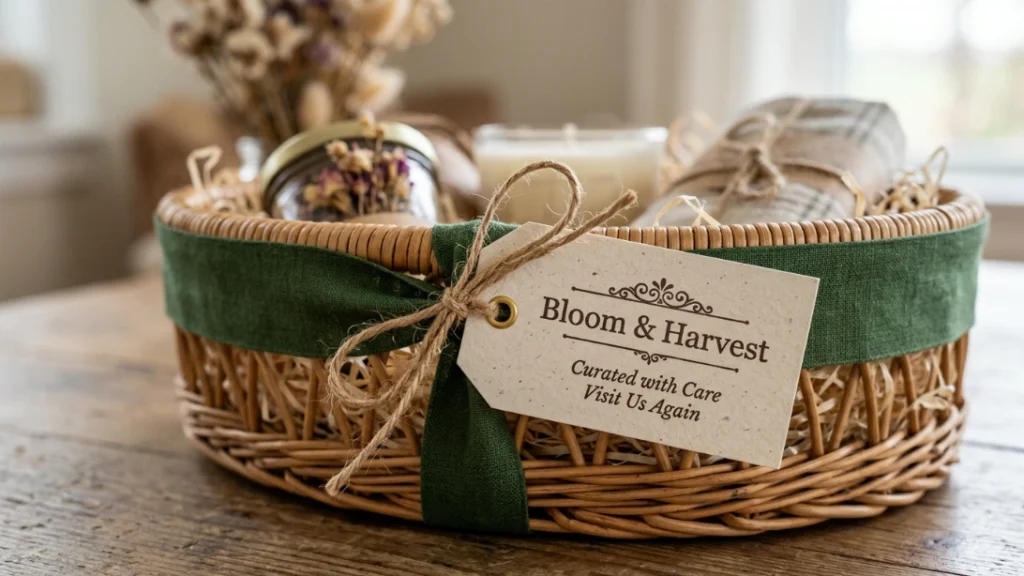
The single most effective, nearly free marketing tool in this entire business is the branded tag attached to every basket that leaves your home. A small, well-designed tag with your business name, contact information, and a simple line inviting the recipient to order something similar turns every single gift you make into a piece of marketing that reaches someone who never would have found you otherwise.
Common Mistakes That Quietly Sink a New Home Gift Basket Business
Underpricing out of fear of losing a sale is the most common mistake. A basket priced only slightly above material cost, with no accounting for real time spent sourcing, assembling, and packaging, quietly guarantees the business can never grow past a hobby-level income, since there’s no margin left to reinvest.
Offering too broad a product line is a close second. A seller trying to be everything to everyone ends up with a sourcing list that’s expensive and inefficient to maintain, and a brand identity that’s genuinely hard for a customer to describe or recommend to someone else.
Relying entirely on individual, one-off orders rather than building toward business relationships is another common ceiling. A home gift basket business that never develops any repeat B2B relationship tends to plateau at a modest, inconsistent income rather than growing into something more stable.
And skipping the packaging finish entirely undersells the actual quality of what’s inside. A customer forms an impression of value within seconds of seeing a product photo, and an unfinished-looking package undercuts everything done well in the sourcing and assembly stages.
Scaling Beyond the First Few Months
Once a home gift basket business has a working system, a defined niche, a repeatable process, and at least one steady sales channel, the natural next step is deciding how to grow without losing the quality that made the early baskets work in the first place.
Batching production around predictable demand windows, the weeks before major holidays, a known local wedding or graduation season, lets a single seller produce a larger volume in a shorter, planned window rather than scrambling reactively.
As order volume grows, shifting from individual retail sourcing toward wholesale distributors or bulk suppliers becomes worth the transition, since unit costs typically drop meaningfully at higher purchase volumes.
Expanding a proven niche into a small connected product line tends to grow revenue more sustainably than launching an entirely unrelated new niche from scratch, since it builds on sourcing relationships, design skills, and brand recognition that already exist.
Where to Start This Week
Pick one specific niche from the list above rather than trying to offer everything at once. Source your first product mix from one or two reliable suppliers, and build your first basket using the structural grid layout and shrink-wrap finish described above, treating it as a genuine practice run rather than your final, polished product. Price it honestly using one of the cost-based formulas, itemizing every single component rather than estimating.
Once you have one or two finished, well-photographed baskets, list them on a local marketplace platform and post them to social media with relevant hashtags. In parallel, identify two or three local real estate agents or small businesses that might be a fit for a bulk gifting relationship, and reach out directly with a sample offer rather than waiting for them to find you.
People Also Ask
How much does it cost to start a home gift basket business?
Startup costs vary widely depending on your niche and how much inventory you buy upfront, but many sellers start small, sourcing only enough materials for a handful of initial baskets, and reinvest profits to grow inventory gradually.
Do I need a business license to sell gift baskets from home?
Requirements vary by city and state, so checking your local zoning rules and whether a home occupation permit applies is an essential first step. If your baskets include alcohol, additional state-specific permits typically apply.
What’s the best way to price a homemade gift basket?
Start by itemizing every single cost that goes into the basket, then apply a cost-based formula, doubling costs at minimum, or doubling and adding a markup for labor and design time, rather than guessing at a number that simply feels right.
How do real estate agents fit into a gift basket business?
Real estate agents regularly need closing and client appreciation gifts, and a single relationship can lead to recurring bulk orders around closing seasons or holidays, making this one of the most reliable B2B channels for a home-based gift basket business.
What should go into a non-perishable gourmet gift basket?
A strong mix includes a sturdy base item like crackers or breadsticks, a few specialty spreads or jams in glass jars, a savory element, and a shelf-stable sweet finish, all chosen specifically because none of it spoils in transit.
Can a home gift basket business realistically become a full-time income?
For some sellers, yes, particularly those who build consistent B2B relationships with real estate agents or corporate clients rather than relying solely on individual seasonal orders, though the timeline and scale vary significantly.