

Virtual Assistant Jobs: 3 Honest Paths to $50/Hr
Virtual assistant jobs are not all created equal, and nobody warned me about that when I started. I spent almost two years doing general admin work — scheduling, inbox management, basic data entry — and I topped out at $22 an hour on a good month. Then I watched someone in an online community post that she’d just landed a CRM management client at $52 an hour. Same laptop. Same work-from-home setup. Completely different result.
The difference wasn’t how many hours she worked or how long she’d been doing it. It was what she specialised in. General virtual assistant jobs are crowded and clients know it. The moment you can point to a specific platform, a specific workflow, or a specific business problem you solve, the rate conversation changes completely. That’s what this article is about.
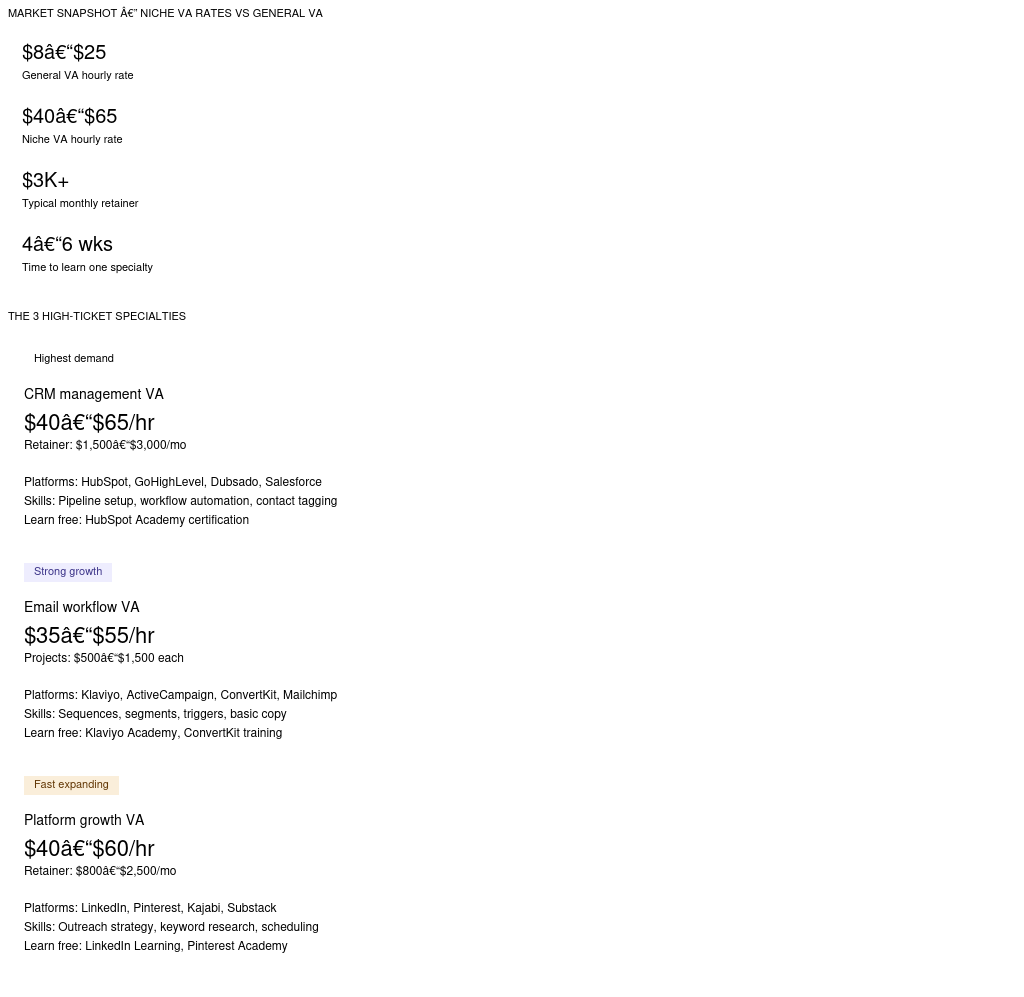
Market snapshot: niche VA rates vs general VA
Why Most Virtual Assistant Jobs Disappoint
The VA industry has a marketing problem. Courses and coaches have spent years selling the idea that anyone can make great money doing general admin work from home. And technically, yes. But the reality is that general virtual assistant jobs are competing against a global pool of workers, and the rates reflect that. On platforms like Upwork and Fiverr, you’ll find general VAs charging anywhere from $8 to $25 an hour. The work is real. The pay ceiling is low.
There are two reasons the gap is so wide between general and specialised work from home jobs. First, general tasks are easy to hand off to anyone, which means clients feel no urgency to pay more. Second, niche skills are genuinely harder to find. A business owner who needs someone to manage their HubSpot pipeline, rebuild their email sequences, or run their LinkedIn outreach isn’t just looking for a warm body at a keyboard. They need someone who actually knows the tool and the strategy behind it. That person is worth significantly more, and most smart business owners understand this.
The other mistake general VAs make is pricing by time instead of by outcome. A client doesn’t care how many hours you spend reorganising their inbox. They care that their inbox is clean, their leads are followed up, and nothing falls through the cracks. The moment you can speak in outcomes, you stop competing on hourly rate.
The 3 Virtual Assistant Jobs Paying $40–$65/Hr Right Now
This is where the market is actually moving. These aren’t theoretical niches — they’re active, in-demand specialties where clients are consistently willing to pay more because the alternative (hiring someone without the skill, or doing it themselves badly) costs them more in lost revenue.
CRM Management VA ($40–$65/hr)
CRM stands for Customer Relationship Management, and the platforms — HubSpot, Salesforce, GoHighLevel, Dubsado — are where most small to mid-size businesses quietly fall apart. Leads come in and nothing happens. Follow-up sequences never get built. The pipeline has stages that nobody updates. The business owner knows it’s broken but doesn’t have time to fix it.
A VA who can come in and clean up a CRM, build workflows, tag contacts properly, and set up automated follow-up sequences is solving a problem that directly costs the client money. That’s not a $20/hr task. CRM-specialist virtual assistant jobs regularly list at $40 to $65 an hour, and retainer clients often pay $1,500 to $3,000 a month for ongoing management.
You don’t need to know every platform. Pick one. HubSpot has free certification courses. GoHighLevel is growing fast in the agency space and there’s high demand for people who actually understand it. Spend four to six weeks learning one platform deeply enough to articulate what you can do with it, and you have a speciality.
Email Workflow VA ($35–$55/hr)
This one surprises people. Email feels basic. But email workflow is not the same as email management. An email workflow VA isn’t checking someone’s inbox — she’s building and managing the automated sequences that run inside platforms like Klaviyo, ActiveCampaign, ConvertKit, or Mailchimp. Welcome sequences. Abandoned cart flows. Re-engagement campaigns. Nurture series for new leads.
These sequences generate revenue while the business owner sleeps. When they break, the business loses money. When they’re set up well, conversion rates improve and the client can see it in their numbers. That connection between your work and their revenue is exactly why this is one of the highest-value virtual assistant jobs available right now.
High paying remote work in this space tends to require you to understand both the technical setup (segments, triggers, conditions) and basic copywriting. You don’t need to be a professional copywriter. You need to write clearly and understand what the sequence is supposed to do at each stage. If you’re already a decent writer, you’re probably closer to this than you think.
Platform-Specific Growth VA ($40–$60/hr)
The third category is the broadest but potentially the most lucrative. Businesses need help growing on specific platforms — LinkedIn, Pinterest, Substack, Kajabi, Teachable — and they need someone who actually understands the platform’s mechanics, not just how to post content. LinkedIn outreach strategy. Pinterest keyword research and pin scheduling. Kajabi course setup and member management. These are specific, learnable, demonstrable skills.
The reason this pays well is the same as the others: specificity signals competence. When you can say “I manage LinkedIn outreach for B2B coaches using Sales Navigator and a three-message sequence,” you sound nothing like a general VA. You sound like a specialist with a method. That’s what clients in this space are actively looking for, and it’s one of the fastest-growing categories in online income for women in 2026.
The Hard Numbers: What to Actually Expect
Let’s be direct about the money. According to the Bureau of Labor Statistics, the median pay for administrative assistants in the US is around $47,000 a year. General VA work from home typically falls below that. Specialised VA work sits well above it.
Here’s what the ranges actually look like across the three niches:
CRM management VAs: $40 to $65 per hour. Retainer clients averaging $1,500 to $3,000 per month. Two or three solid retainer clients puts you between $3,000 and $9,000 a month, which is somewhere between $36,000 and $108,000 a year depending on how many clients you take on.
Email workflow VAs: $35 to $55 per hour for ongoing management. Project-based setup work (building a full welcome series, for example) often bills at $500 to $1,500 per project. A mix of project and retainer work is common in this niche.
Platform growth VAs: $40 to $60 per hour. Monthly retainers vary widely but $800 to $2,500 per client is typical for consistent work. LinkedIn specialists can charge more for outreach management.
The honest timeline for moving from general VA work to niche VA work is a few months, not a few weeks. Four to six weeks to learn the skill, four to eight weeks to land the first niche client. Some people move faster. Plan for slower and be pleasantly surprised.
The Skills You Already Have That Transfer
This is the part I want you to actually sit with. If you’ve been doing any kind of VA or admin work, you already have more than you think.
You know how to manage competing priorities. That transfers directly into CRM pipeline management. You know how to communicate clearly in writing. That transfers into email workflow copy. You’ve probably used at least one project management tool or scheduling platform. That muscle — learning a new tool quickly and figuring out its logic — is the exact skill that makes niche VA work learnable.
You don’t need a degree. You don’t need years of experience in a specific platform. You need a few weeks of focused learning, one platform you can genuinely claim to know, and the ability to explain what problem you solve. That’s it.
If you’re not sure which direction fits you best, read through the guide on building a freelance approach that actually works long-term — it covers the positioning piece in detail and will help you avoid the mistakes that keep most freelancers stuck at low rates.
What Your First Month Actually Looks Like
Week one: pick your niche. Just one. Look at the three specialties above and ask yourself which platform you’d be most willing to spend time learning. Not which one sounds most impressive. Which one you’d actually sit down with on a Tuesday night. That’s your answer.
Week two and three: learn the tool. Free resources first. HubSpot Academy, Klaviyo’s learning portal, LinkedIn Learning. Get hands-on inside a free trial account and build something, even if it’s fake. A fake CRM pipeline you built to practice is still a portfolio piece.
Week four: reach out to five people. Not to sell, to offer. Tell a small business owner you know that you’re building your CRM management skills and you’d like to do a 30-day free or reduced-rate project in exchange for a testimonial. One yes is all you need. That first case study becomes the thing you show every client after it.
By the end of month two, virtual assistant jobs at $40 or more per hour aren’t a distant goal. They’re a realistic next step, and you’ll have the evidence to back up the rate.
The Honest Summary
General virtual assistant jobs are not going away, but the market for them is tight and the pay ceiling is low. The women earning $50 an hour or more as VAs aren’t working harder than everyone else. They chose a specific skill, learned it well enough to speak about it confidently, and found clients who had that specific problem.
That path is open to you. It takes a few months, not a few years. It takes choosing one platform, not mastering all of them. Virtual assistant jobs at the niche level are genuinely one of the most accessible high-paying remote options available right now — and the barrier to entry is lower than most people assume. Pick your niche this week. Everything else follows from there.
Read More:
Cheap Wedding Venues: 10 Real Ideas Under $5K
Money and Self Worth: 5 Secret Steps to Lasting Peace