
She Filmed Her Best Friend’s Wedding On A Phone, Then Started Charging For It
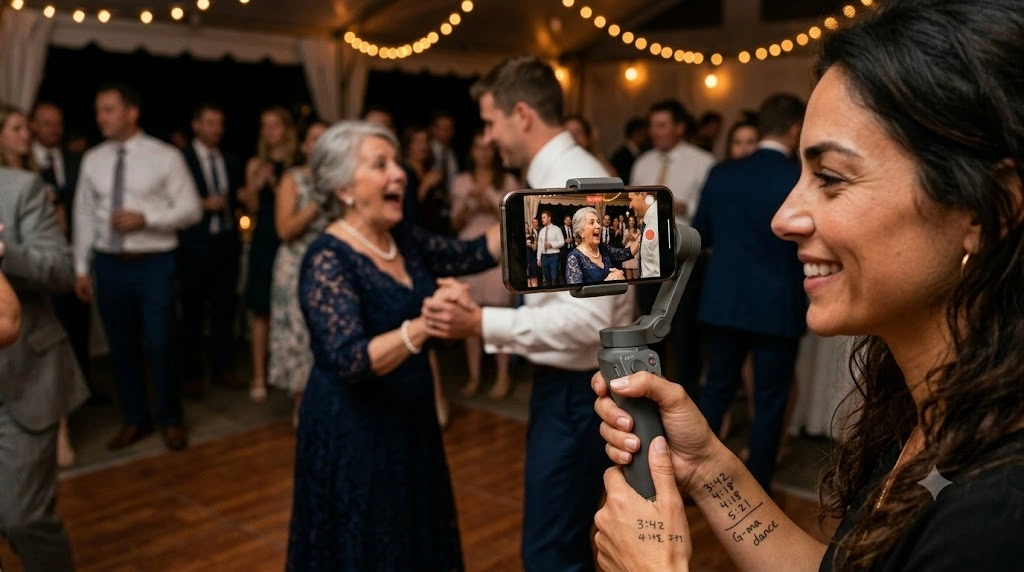
She is standing at the edge of the dance floor with her phone in one hand and a tiny gimbal in the other, watching the groom’s grandmother get pulled into a slow dance she clearly did not plan on. Nobody else in the room catches it, because everyone else is either dancing or half a drink into not paying attention. She does. She has spent the last four hours quietly noticing exactly this kind of moment, and by tomorrow morning the couple will wake up to a video of it before they have even opened their eyes.
This is what being a wedding content creator actually looks like in 2026, and it is nothing like the polished, faraway job it sounds like from the outside. It is a real, teachable, phone-first skill that a mom, a teenager, a single mom rebuilding her finances, or a woman starting over after a divorce can genuinely learn and get paid for, often starting with a phone she already owns. If you have wondered how to become a wedding content creator with no experience and no camera bag full of gear, the answer is more accessible than almost anyone selling a course on it wants you to believe.
A wedding content creator is a phone-based storyteller hired separately from the photographer and videographer to capture same-day, social-ready video, reels, and behind-the-scenes footage that couples receive within 24 to 48 hours instead of waiting months. Packages commonly range from a few hundred dollars for a half day to well over a thousand for full coverage. Anyone with a newer smartphone, a steady hand, and a genuine eye for real moments can realistically start booking small jobs within a season.
Why Most People Misunderstand Wedding Content Creator Work
The biggest misread of this job is thinking it means showing up as a friend with a nicer phone. That assumption keeps genuinely capable women from ever trying it, because it makes the whole thing sound like it does not require real skill. It does. A wedding content creator has to notice a feeling twenty seconds before it happens, not after, which is a completely different muscle than pointing a camera at whatever is already obviously happening, and it is a muscle that gets stronger with every single event you shoot, not something you either have or do not have on day one.
The second misunderstanding runs the opposite direction. Some women assume this job requires the same equipment budget as a professional photographer, cinema cameras, multiple lenses, years of formal training. It does not. The entire appeal of this role, both for couples hiring it and for women considering it as income, is that the tools are intentionally lightweight, which is exactly why it has become such an accessible entry point compared to almost every other wedding vendor role. A recent smartphone and a basic stabilizer cover most of what a beginner actually needs to book a first job.
The third mistake is treating a wedding content creator as a smaller, cheaper version of a videographer. It is a different job entirely, not a discount one. A videographer builds a polished, long film meant to be watched on an anniversary decades from now. A content creator captures the immediate, in-between feeling of the day itself, the version couples want to see the morning after while it still feels real. Couples increasingly book both, not one instead of the other, because each one is answering a different emotional need.
There is a fourth misunderstanding worth naming, because it is the one that quietly convinces couples this role is worth the money in the first place. Hiring a dedicated content creator often means guests can actually put their phones away. When nobody in the crowd feels responsible for capturing the ceremony on their own device, an unplugged wedding becomes genuinely possible instead of a rule nobody follows. That single shift, guests fully present instead of half-watching through a screen, is a real selling point you can speak to honestly when a couple asks why this is worth adding to their vendor list.
What A Wedding Content Creator Actually Does
A wedding content creator spends the day capturing raw, real-time footage on a phone rather than a traditional camera, then turns a portion of it into short, edited clips the couple can post almost immediately. Where a photographer focuses on posed portraits and a videographer builds a cinematic narrative for the years ahead, the content creator’s entire job is speed and authenticity. Think of the getting-ready chaos, the flower girl who refuses to walk down the aisle, the best man visibly panicking about his toast. Those moments rarely make it into a traditional gallery, but they are exactly what a couple wants to see again the next morning.
It helps to think of the difference as legacy versus perspective. A photographer and videographer are building the legacy pieces, the images and film a couple will still be showing their grandchildren decades from now, which is exactly why those deliverables take longer and cost more. A content creator is capturing perspective, the felt experience of being inside that specific day, which loses almost none of its value by being fast and a little imperfect. Neither approach is better. They are simply answering two different questions a couple has about their own wedding: what will this look like forever, and what did this actually feel like while it was happening.
Same-day or next-morning delivery is the defining feature of this role, and it is also the biggest reason couples are willing to pay for it separately from their other vendors. Waiting weeks for professional photos used to be the norm. Now, a couple can go to sleep married and wake up to a folder of real, shareable footage from their own wedding day, sometimes alongside private social posts made on their behalf while they were too busy dancing to touch their own phone.
Working well alongside the rest of the wedding vendor team is not optional, it is the single fastest way a new creator either builds a good reputation or ruins one before it starts. A photographer and videographer are usually on-site for the same key moments you are trying to capture, and the goal is never to compete with them for the same angle or block their shot.
The professional move is a quick introduction to the full vendor team the moment you arrive, a short conversation about who is covering what, and a habit of staying slightly out of the primary sightlines during formal moments like the ceremony and first look. Wedding planners remember which new vendors made their job easier and which ones caused friction, and that memory is often where your next referral actually comes from.
One increasingly requested add-on is managing the couple’s social accounts for the day itself, posting real-time updates on their behalf so they can stay fully present instead of narrating their own wedding through a phone screen. Done well, it means guests genuinely cannot tell the couple is not the one posting, because the creator has spent time beforehand learning how that specific couple talks, what kind of captions they would actually write, and which small details they would want shared first. It is a more advanced service worth adding once your basic workflow feels solid, not something to attempt on a first booking while you are still learning the fundamentals.
Starting With Zero Experience Or Equipment Budget
You do not need a professional camera, a film degree, or years of shooting experience to start. This really is how to become a wedding content creator with no experience in the traditional sense, since what you actually need is a phone from the last few years, a basic stabilizer, and the willingness to practice noticing moments before they happen rather than after. Most creators who are doing this well right now started with exactly that setup and learned the rest by doing real events, not by studying theory first.
The realistic starter kit looks like this: a smartphone capable of shooting sharp 4K video, a simple handheld stabilizer to smooth out walking shots, a portable charger so a ten hour wedding day does not end with a dead phone at cocktail hour, and a basic clip-on microphone if you plan to capture vows or speeches up close. None of this requires a business loan. Most of it can be built up piece by piece as the first few bookings start paying for themselves.
The learning curve is real but shallow, much like starting any hands-on side income. A handful of camera settings genuinely matter more than the rest: shooting in a high resolution setting for a crisp, professional look, keeping stabilization turned on so walking footage does not feel shaky, and turning off automatic macro switching so close-up shots of rings and details do not blur unexpectedly. Most phones also let you turn on a visible grid line, which makes it far easier to keep a shot level without thinking about it consciously during a fast-moving moment. Learning these five or six settings well beats owning expensive gear you do not fully understand yet.
Redundancy is the one habit worth building from your very first paid booking, long before it feels necessary. Saving footage to only one place, a single phone with no backup, is the kind of mistake that can end a young reputation in a single afternoon if a device is lost, dropped, or simply fills up mid-reception. A simple routine, transferring footage to a laptop and a cloud backup before you even leave the venue parking lot, costs nothing but a few extra minutes and protects an entire day of irreplaceable footage.
If You’re A Teen, A Single Mom, Or Rebuilding After Divorce
A teenager already fluent in short-form video editing and trending audio has a genuine head start here, since half the job is understanding how content actually performs on a phone screen, not a movie screen. What she is usually missing is not skill but trust, which is why starting with a family friend’s wedding or a styled shoot for a local vendor builds the kind of portfolio a stranger will eventually pay to book. Working alongside a parent or another adult vendor on those first few bookings also solves the age and liability questions that come up naturally when a minor is handling paid client work.
A single mom fitting this around an unpredictable schedule benefits from how contained a single wedding day is. Unlike an ongoing client relationship that demands attention all week, a wedding booking is one defined day with a clear start and end time, followed by focused editing hours that can happen late at night once kids are asleep. That structure suits someone whose time comes in blocks rather than a steady stream. Weekend weddings also tend to line up naturally with a coparenting schedule that already frees up certain weekends more than weekdays.
A woman rebuilding her income and her confidence after a divorce often already has the single most important skill this job requires without realizing it: the ability to read a room and notice what a person is actually feeling underneath what they are saying. That is not a technical skill anyone teaches in a course. It is something life teaches, and it happens to be exactly what separates forgettable wedding footage from the kind couples watch on repeat. There is also something genuinely full circle about building a new income stream around other people’s biggest romantic milestone while rebuilding your own financial independence, though that is a private meaning you get to decide for yourself, not a marketing angle to lead with when talking to clients.
A mom who has spent years documenting her own children’s chaos without ever calling it a skill often has the steadiest hands and the calmest instincts of anyone on this list. Years of trying to catch a toddler’s actual smile instead of a forced one translates directly into knowing exactly when to hit record during a wedding toast, before the emotional moment has already passed.
A Real Wedding Day, Start To Finish
Understanding the actual shape of a wedding day matters more than any single piece of equipment, because it tells you where your energy and attention need to go. The job also starts well before the wedding date itself, not on the morning of.
In the weeks leading up to the wedding, typically anywhere from ten weeks out to about a month before, the real preparation work happens. A short questionnaire sent to the couple, asking about the people and moments that matter most to them, does more for the final result than any equipment upgrade could. A quick call to confirm the timeline, the locations, and any specific trends or styles the couple wants recreated turns a stranger’s wedding into a day you already understand before you arrive. This is also when a smart new creator reaches out to the couple’s photographer and planner directly, introducing themselves and confirming how the day will be shared between vendors, so nobody is surprised or stepping on anyone else’s coverage when the day actually arrives. Couples notice this kind of preparation even when they never see it happen directly, because it shows up as a calmer, more organized presence on the day itself.
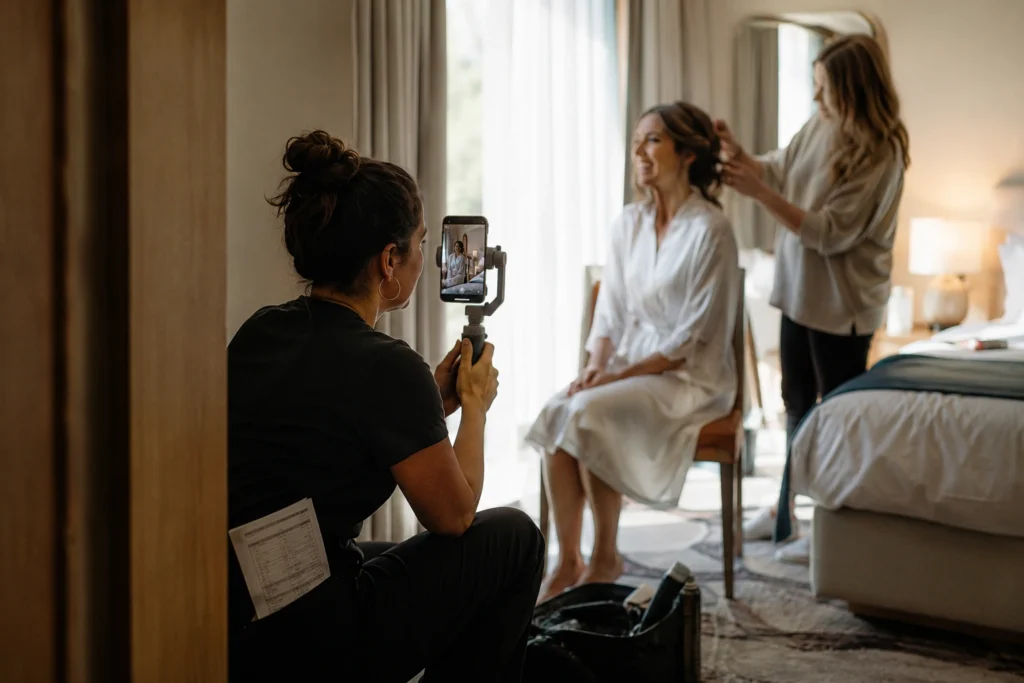
The morning starts early, often before the sun is fully up, with a check of every device, a battery already fully charged, and a mental run-through of the couple’s must-have moments discussed weeks earlier. Getting-ready coverage is where a content creator earns trust fastest, staying quiet and mostly unnoticed while capturing the shift from a nervous, relaxed morning into the focused energy right before the ceremony. This is also when the small, unscripted before shots get captured, the ones that make an after transition video feel earned rather than staged.
During the ceremony itself, the job becomes about staying invisible while catching real reactions, a mother’s face during the walk down the aisle, a groom’s hands shaking slightly as he waits. Cocktail hour flips the energy entirely. While the couple disappears for formal portraits with the photographer, the content creator moves through the crowd, capturing genuine guest reactions and short, casual moments that end up being some of the most rewatched clips later. This is often where the best unscripted content of the entire day happens, a grandmother telling an old story, two guests reconnecting after years apart, none of it plannable in advance and all of it far more valuable than another posed group photo.
The reception is where the job gets physically demanding and creatively rewarding at the same time, hours of movement, low light, and a real test of whether those camera settings were dialed in correctly earlier in the day. Good lighting becomes the biggest technical challenge here, since a dark dance floor with fast movement is exactly the scenario a beginner’s setup struggles with most. A small clip-on light and a bit of practice shooting in low light beforehand make a visible difference in the final footage quality. By the time the last dance ends, most content creators have been working for eight to twelve hours straight, and the job is not actually finished yet.
What happens after the wedding is arguably the part outsiders never picture. Footage needs to be backed up in more than one place immediately, since losing an entire wedding’s worth of footage to a single failed device is the kind of mistake that ends a young business before it starts. A simple, repeatable system, saving to the phone, a laptop, and a cloud backup, protects against that risk without requiring anything expensive. Editing then happens overnight or first thing the next morning, turning raw footage into a handful of short, polished clips the couple can post immediately, with the full raw footage delivered alongside it.
Organizing footage as it comes in, rather than facing one enormous unsorted folder at midnight, saves real time on delivery day. A simple habit of separating clips into a few clearly labeled folders throughout the day, getting ready, ceremony, reception highlights, turns an overwhelming edit into a manageable one. This is also where a couple’s earlier questionnaire pays off again, since knowing in advance which three or four moments mattered most to them means the overnight edit can prioritize exactly those clips first, rather than scrolling through hours of footage trying to guess what they will care about most.

The Hard Numbers Behind Wedding Content Creator Income
Real numbers matter more here than vague encouragement, so here is what current pricing actually looks like based on industry reporting rather than a single guess.
| Package Type | Typical Range | What It Usually Covers |
|---|---|---|
| Starter or half-day | Roughly $300 to $600 | Around 4 hours, key highlight moments only |
| Standard full-day | Roughly $600 to $1,500 | 8 to 10 hours of coverage, raw footage plus edited highlights |
| Premium or dual-operator | Often $1,300 and up | Full day, two shooters, sometimes drone footage added |
These ranges come from current industry reporting across multiple markets, not a single confirmed government source, so treat them as a realistic starting map rather than a guarantee for your specific area. Local cost of living, your portfolio strength, and how competitive your specific market already is will all shift where you actually land within that range.
A brand new creator with zero paid bookings yet should expect to start toward the lower end of that starter range, sometimes even offering a reduced first rate in exchange for a strong portfolio piece and a genuine review. That is not underselling yourself. It is the same trade every service-based business makes in its first few months, trading a slightly lower rate now for the proof that lets you charge full price later.
Some photographers have started folding content creation into their own offering as an add-on service rather than a separate booking, sometimes priced as a bundled package well above what a standalone content creator would charge alone. That trend is worth knowing about, not because you need to compete with it right away, but because it signals real, growing demand for this exact skill from an entirely different direction, established photographers who are choosing to learn it themselves rather than watch couples hire someone else for it.
Startup costs stay genuinely low compared to most creative side hustles. Here is a realistic breakdown of what actually needs to be spent before a first booking:
| Item | Realistic Starting Cost | Notes |
|---|---|---|
| Smartphone | $0 if you already own a recent model | The single most important tool, no separate camera needed to start |
| Basic gimbal or stabilizer | Roughly $50 to $150 | Smooths out walking and dancing footage significantly |
| Portable charger | Roughly $20 to $40 | Non-negotiable for a full-day booking |
| Editing app | Often free to start | Paid upgrades worth considering only after real bookings begin |
| Clip-on microphone | Roughly $30 to $80 | Optional at first, valuable once you are booking vow and speech coverage |
Software for editing can start entirely free using mobile apps built for exactly this kind of fast-turnaround work, with paid upgrades only worth considering once a few real bookings are covering the cost.
If you are earning $400 or more in net self-employment income in a year, you are required to report that income and may owe self-employment tax on it, even from a handful of weekend weddings. I am not a financial advisor and this is not financial advice. For your specific situation, talk to a qualified professional, once bookings start becoming a real, recurring part of your income.
Picture it concretely instead of abstractly. A new wedding content creator booking one wedding every other weekend during a six month wedding season, at an average of $500 per booking while still building a portfolio, brings in roughly $6,000 across that stretch, working around a single weekend day each time rather than a full work week. That is not a full-time replacement income on its own, but it is a genuinely realistic second income stream for a single mom or a woman rebuilding after divorce, especially since the actual working hours are concentrated into weekend days rather than spread thin across every evening.
Confidence around your own pricing is the real hurdle here, more than any material cost. New creators consistently underprice their first several bookings out of nerves, not out of any real market signal telling them to charge less. A simple habit fixes this faster than anything else: write your rate sheet down before your first inquiry ever arrives, so you are quoting a number you already decided on calmly, not one you are inventing under pressure while a stranger waits for a reply.

The Skills You Already Have That This Work Actually Pays For
Women underestimate how much of this job they have already been practicing for free, often for years, without ever calling it a business skill.
If you have ever anticipated a toddler’s meltdown thirty seconds before it happened, you already have the exact instinct this job is built on, noticing an emotional shift right before it becomes visible to everyone else. If you have ever managed a room full of relatives during a holiday, you already understand how to read tension and joy in the same space without anyone having to explain it to you. If you have ever kept a group chat organized, sent a thoughtful follow-up message, or remembered a small detail someone mentioned once in passing, you already have the communication instincts that turn a one-time booking into a couple recommending you to three of their engaged friends.
A definition worth having here: same-day delivery, sometimes called next-morning delivery, simply means the couple receives their content within 24 to 48 hours of the event ending, instead of the six to twelve week wait that is standard for a traditional photography gallery. That single difference is the entire reason this role exists as its own paid position rather than being folded into what a photographer already does.
Teenagers often bring the sharpest instinct for what actually performs well on a phone screen, since they have been watching and making short-form video their whole conscious lives, long before it became a paid skill. Divorced women rebuilding financial independence often bring something couples respond to without fully naming it, a steadiness that comes from having already survived something hard, which shows up as calm, capable energy on a day that is inherently a little chaotic for everyone else involved.
Once a few real bookings start coming in, treating this as an actual small business, not a casual favor for friends of friends, is what turns occasional income into something steadier. That does not require anything complicated.
A simple way for couples to pay you, a short written agreement covering what you will deliver and by when, and a basic understanding of whether your area requires any kind of local business registration are the three things worth setting up early rather than scrambling for after your third or fourth booking. None of this needs to happen before your first shoot. It needs to happen before this stops feeling like a one-time favor and starts feeling like income you can count on, and reaching that point is far more realistic within a single wedding season than most new creators expect going in.

What Your First Two Months As A Wedding Content Creator Look Like
Week one is entirely about building proof, not booking paid work yet. Reach out to one engaged friend, a family member planning a wedding, or a local vendor willing to trade a styled shoot for usage rights. The goal is a single, real event to practice the full workflow from start to finish, not a perfect one.
Week two is about turning that first shoot into an actual portfolio. Edit three to five short clips that genuinely represent your style, post them somewhere couples can find them, and write one honest caption explaining what you offer and why. This is also the week to build a simple one-page rate sheet, even if the numbers on it are still a guess you plan to adjust.
Week three is for reaching out, quietly and specifically. Message a handful of local wedding planners or venues, not to ask for a favor, but to introduce yourself as a new option for their upcoming couples. A short, genuine message with your portfolio link attached does more than a generic listing on a vendor directory ever will at this stage.
Week four is your first real test of patience. Bookings at this stage are unpredictable, and a quiet inbox does not mean the idea failed. A single mom working around a custody schedule might stretch these four weeks into eight, and that pace is completely reasonable. A teenager fitting this around school might move faster over a summer break and slower once classes resume. There is no fixed timeline that applies to everyone equally here.
Weeks five and six are usually when the first real inquiry shows up, often from someone who saw your portfolio through a shared connection rather than a cold search. This is the moment to have your rate sheet and a simple booking process ready, so a genuinely interested couple does not lose momentum waiting on you to figure out logistics you should have settled weeks earlier. Weeks seven and eight, if a first paid booking has happened by then, are about asking for a short, honest review and permission to share more of the footage publicly, since that single piece of social proof does more for your next booking than another month of cold outreach would.
By the end of a realistic first two months, most new creators have one completed shoot, a small handful of edited portfolio clips, one or two genuine inquiries in progress, and possibly one small paid booking. That is not a slow start. That is the actual, unglamorous foundation every currently booked-out creator quietly built first, usually while still working another job entirely.

Related reading if you are weighing this against other income paths: our guide to async income models for single moms covers digital income options that do not require a fixed schedule, and our breakdown of starting an Etsy shop with no money walks through a similar zero-to-low-investment starting point if hands-on filming is not the right fit for you right now. Both paths share the same underlying idea this entire guide is built on, that a real skill you already have is usually worth more than the equipment or credentials you think you are missing.
People Also Ask
What does a wedding content creator actually do?
A wedding content creator captures same-day, phone-based video and photos throughout a wedding, focused on raw, behind-the-scenes moments rather than posed portraits, then delivers a set of edited, shareable clips within 24 to 48 hours. This is different from a photographer or videographer, who typically deliver polished galleries and films over a much longer timeline, and the three roles are usually booked together rather than as substitutes for one another.
How much does a wedding content creator make?
Based on current industry reporting, a single wedding booking commonly falls between $300 for a shorter starter package and $1,500 or more for a full day of premium coverage, with brand new creators typically starting toward the lower end while building a portfolio. Consistent monthly income depends heavily on how many weddings you can realistically book during peak wedding season, which in most of the US runs roughly from late spring through early fall.
Do you need a professional camera to become a wedding content creator?
No, a recent smartphone capable of shooting high-resolution video is the standard tool for this job, paired with a basic stabilizer and portable charger. Professional cinema cameras are the domain of traditional videographers, not content creators, whose entire value comes from a fast, mobile, authentic style rather than cinematic equipment, so investing in expensive gear early is rarely the right first move.
Is a wedding content creator the same as a videographer?
No, and couples increasingly book both for the same wedding. A videographer builds a long, cinematic film meant to be watched for decades, while a wedding content creator focuses on same-day, social-ready clips that capture the immediate feeling of the event. The two roles are complementary rather than competing, and it is common courtesy for a content creator to coordinate with the photography and video team rather than compete with them for space during key moments like the ceremony.
How do I get my first wedding content creator client with no experience?
Start with a friend or family member’s wedding, or offer a discounted first booking to a couple you already know, in exchange for permission to use the footage in your portfolio. Three to five strong, real examples are usually enough to start attracting genuine paid inquiries, especially when shared with local wedding vendors who are regularly asked for recommendations by their own couples.
One Thing To Do Before You Close This Tab
If you take nothing else from this, take this: becoming a wedding content creator does not require permission, a portfolio you do not have yet, or equipment you cannot afford. Anyone genuinely asking how to become a wedding content creator with no experience already has the two things that matter most, a phone and a willingness to notice a moment before it happens instead of after.
Message one engaged friend this week, even if it feels a little awkward to ask. You can improve your editing next month. You cannot build a portfolio around a wedding you never showed up to film.