

Frugal Chic: How to Dress Expensive on Any Budget
There’s a specific kind of standing-in-front-of-the-closet moment that has nothing to do with how many clothes are actually in it. The closet is full. The feeling of having nothing to wear persists anyway. It’s worth sitting with that contradiction for a second, because the gap between a full closet and the feeling of having nothing in it is not a clothing problem. It’s a different problem wearing a clothing costume.
Frugal chic style, the current name for an old idea, intentional repetition and styling skill over constant newness, exists because enough women have noticed the same thing independently. The closet was never the issue. The belief that looking put together requires continuous purchasing was the issue, and it’s worth examining directly rather than solving with another trip to the mall that quiets the feeling for exactly as long as the bag stays unopened in the corner.
Frugal chic style means looking intentional and put together without a large clothing budget. The method works by reducing daily outfit decisions to a small, curated set of pieces that mix and match across every occasion. Most women who master this approach spend significantly less per year on clothing than before, while feeling more confident about how they look.
What Nobody Tells You About Looking “Put Together”
The assumption running underneath most clothing spending is rarely stated out loud, but it shapes almost every purchase decision: that looking expensive, polished, put together, requires visible newness. New pieces. Frequent purchases. A wardrobe that’s always slightly ahead of what you wore last month.
This assumption is wrong in a way that’s genuinely useful to understand, because visible newness and visible quality are not the same signal, and most people, including the people whose style reads as effortlessly expensive, are responding to quality and intentional repetition, not frequency of purchase. Frugal chic style as a named trend exists specifically because this gap has become visible enough that people are naming it. Wearing the same well-chosen blazer in five different combinations across a month reads as more put together than five different mediocre new pieces worn once each.
The false belief is specific and worth naming directly: that the feeling of having nothing to wear gets solved by buying something new. It doesn’t. It gets solved temporarily, for the length of one outfit, and then the same feeling returns, often faster than before, because the new item hasn’t actually addressed what was missing. What’s usually missing isn’t a garment. It’s a system.
The Part Nobody Talks About: Decision Fatigue Wearing a Closet’s Worth of Disguises
Every morning involves a finite amount of good decision-making capacity, and clothing selection is competing for that same limited resource against every other decision the day will require. A closet with forty mediocre, loosely-coordinated pieces requires more decision-making energy each morning than a closet with fifteen pieces that were chosen specifically to work together.
This is the part most style content skips entirely, because it’s easier to sell the next purchase than to explain that the problem might be structural rather than acquisitive. Standing in front of a full closet, mentally trying dozens of combinations that don’t quite work, scrolling past pieces that seemed essential in the store and have never once made it into a complete outfit since, is a genuinely tiring decision-making exercise repeated daily. It is not surprising that it produces the feeling of having nothing to wear. The closet isn’t offering a system. It’s offering options, and options without a system are exhausting rather than freeing.
Frugal chic style, at its actual core, is a decision-reduction strategy disguised as a fashion philosophy. Fewer pieces, deliberately chosen to combine with almost everything else in the closet, means fewer decisions each morning, not more limitation. That distinction matters enormously, because limitation feels like loss and decision reduction feels like relief, and they can describe the exact same wardrobe.
The Frugal Chic Style Formula That Actually Works
This is where the mindset becomes something practical enough to use tomorrow morning, the actual formula behind the frugal chic style approach.
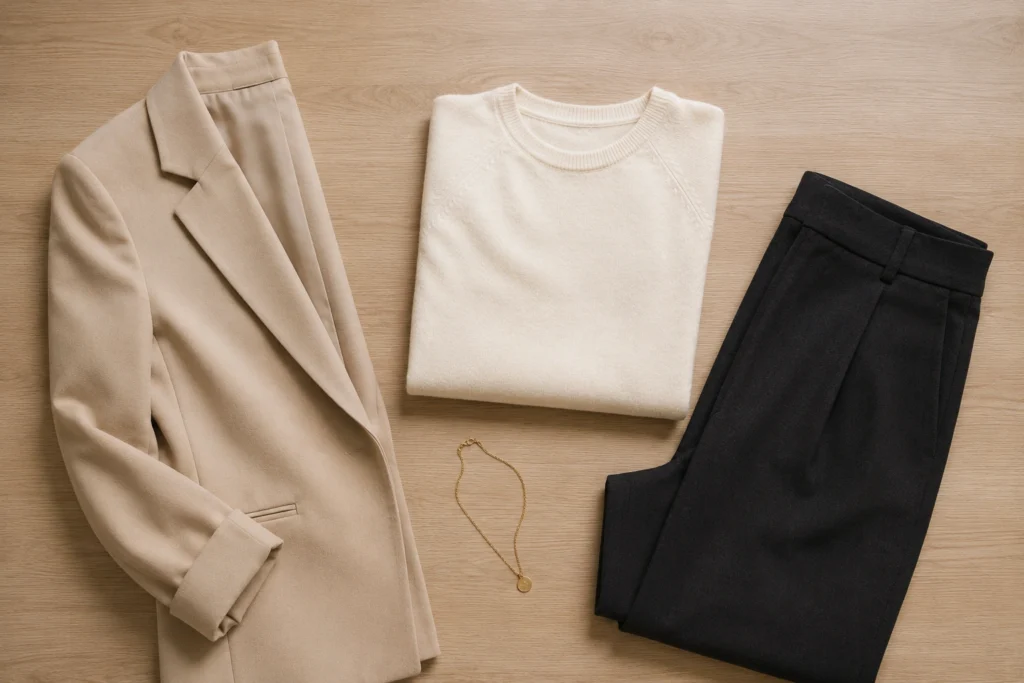
Build around three to five anchor pieces, not an entire wardrobe at once. An anchor piece is something that works in multiple contexts without modification, a well-fitted blazer, a quality pair of trousers in a neutral tone, a simple dress that can be dressed up or down with accessories alone. The goal isn’t owning fewer clothes for its own sake. It’s owning fewer pieces that each work harder, appearing in more outfit combinations than a piece that only pairs with one specific other item.
Repeat deliberately and visibly, rather than hiding repetition. The instinct to avoid wearing the same blazer twice in one week comes from an assumption that repetition reads as having limited resources. The opposite is closer to true. Deliberate repetition, the same trusted blazer styled three different ways across a week, reads as intentional rather than limited, the same way a person with one signature fragrance reads as having a clear identity rather than a small perfume collection.
Let accessories carry the visible “newness” signal instead of full new outfits. A small rotation of well-chosen accessories, a watch, a simple gold necklace, one structured bag, does more visual work per dollar than an equivalent amount spent on additional clothing pieces. This is where frugal chic style differs most sharply from constant-purchase styling: the spending, when it happens, concentrates on a small number of high-impact items rather than spreading thin across a large, loosely coordinated wardrobe.
Where to Actually Find These Pieces
None of this requires new purchases at retail prices to begin. The most efficient starting point is an honest audit of what’s already in the closet, identifying which existing pieces already function as anchor pieces, even if they’ve been buried under newer purchases that never quite earned their place. Thrifted and secondhand pieces, particularly in classic cuts and natural fabrics, frequently fill the anchor-piece role at a fraction of retail pricing, since the goal is fit and quality rather than current-season specificity.

What Frugal Chic Style Actually Costs Compared to Constant Buying
The financial comparison here is less dramatic than a single number suggests, but it compounds in a way that’s worth examining honestly.
A wardrobe built around frequent smaller purchases, a new top every few weeks, an impulse piece that seemed necessary in the moment, adds up steadily across a year without ever producing the sense of having a complete or cohesive wardrobe, because each purchase was reactive rather than part of a system. A frugal chic style approach typically front-loads spending into a smaller number of higher-quality anchor pieces, then slows dramatically, supplemented occasionally with accessories or one seasonal addition rather than continuous purchasing.
The total annual spend often ends up comparable in raw dollar terms, the meaningful difference isn’t always a smaller number, it’s a fundamentally different relationship with the spending. Money spent on three well-chosen anchor pieces produces a wardrobe that functions as a system. The same money spent across fifteen smaller, reactive purchases produces a closet that’s full and still doesn’t solve the morning decision-fatigue problem, because volume was never the variable that mattered.
What changes most concretely is the frequency of the “I have nothing to wear” feeling itself, which tends to decrease substantially once the wardrobe is functioning as an actual system rather than a loose collection of individually appealing pieces that don’t combine well with anything else.
What I Told Myself That Was Wrong About Looking Polished
The specific false belief worth naming directly is this: that looking expensive is a purchasing outcome rather than a styling skill. It’s an understandable belief, because the entire retail industry benefits from it being widely held, and very little content exists to actively contradict it.
The correction isn’t that money doesn’t matter at all to how clothing looks, quality fabric and proper fit genuinely make a visible difference. The correction is that the relationship between spending and appearing put together is not linear and not continuous the way it’s usually presented. A relatively small, well-chosen wardrobe, maintained and styled with actual intention, consistently outperforms a much larger, more expensive wardrobe assembled without a system, in terms of how polished the result actually looks day to day.
This matters beyond the closet, because the same pattern shows up elsewhere in spending psychology. The belief that more purchasing solves a feeling of inadequacy rarely holds up under examination, whether the category is clothing, household items, or anything else marketed as the thing that will finally make daily life feel sufficiently put together. Frugal chic style is a useful, contained place to practice noticing that pattern, because the stakes are low and the feedback is immediate, you can see within a week whether a smaller, more intentional wardrobe actually functions better than the larger one did.
What Honest Looks Like After the Shift
Six weeks into an actual frugal chic style approach, the change isn’t usually described as a wardrobe transformation. It’s described as something quieter: mornings that take less time, fewer moments of standing in front of a full closet feeling stuck, and a wardrobe that, despite containing fewer total pieces, somehow produces more outfits that feel genuinely finished.
The financial picture settles into something specific and sustainable rather than dramatic. Spending doesn’t stop, it redirects, toward fewer, more deliberate purchases and away from the steady reactive trickle that used to fill the closet without ever filling the actual need. The closet stops being a source of quiet daily dissatisfaction and starts functioning the way it was always supposed to, as a tool rather than an ongoing, unresolved project.
What doesn’t change, and shouldn’t be expected to change, is the occasional pull toward something new and trend-driven. That’s a normal, human response to seeing something appealing, not a failure of the system. The difference is that it becomes a deliberate, occasional choice within a working system rather than the default response to a closet that never quite felt complete.
One Thing Before You Go
Stand in front of your closet tonight, not to shop, just to look honestly at what’s already there. Pull out the three pieces you reach for most often without thinking, the ones that already function as anchors even if you’ve never named them that way.
That’s the actual starting point for frugal chic style, not a shopping list, not a capsule wardrobe overhaul completed in one weekend. Just an honest look at what already works, repeated deliberately, styled with intention, before a single new purchase gets considered. The closet that feels empty tonight might already contain more of a system than you’ve given it credit for.
People Also Ask
Question 1:
What is frugal chic style?
Answer:
Frugal chic style is the practice of looking polished and put together on a limited clothing budget by focusing on fit, neutral colors, and a small set of versatile pieces rather than buying frequently. It prioritizes quality of appearance over quantity of items owned.
Question 2:
How do I build a frugal chic wardrobe from scratch?
Answer:
Start with five to seven neutral basics that work together: a well-fitted pair of dark jeans, two plain tops in white and black, one blazer or structured cardigan, one pair of clean simple shoes, and one bag. Everything else is optional until these pieces are in place. Thrift stores and end-of- season sales are the most reliable sources for quality basics at low prices.
Question 3:
Can you really look expensive on a tight budget?
Answer:
Yes, and fit is the single biggest factor. A well-fitted $15 top from a thrift store photographs and reads as more expensive than a poorly fitted $80 blouse. Frugal chic style prioritizes alterations and fit above brand or price tag, which is why it works consistently even on very limited budgets.
Question 4:
What is the difference between frugal chic style and just buying cheap clothes?
Answer:
Frugal chic style is intentional and curated. Buying cheap clothes without a plan produces a cluttered wardrobe of items that don’t work together. Frugal chic means fewer pieces, chosen deliberately, that all connect to each other — so getting dressed takes less time and costs less money over the year than constant impulse buying at low price points.
Read More:
The $5 Manicure Method: Salon Looks Without the Salon Bill
Budgeting for Moms: The Complete 2026 Guide That Actually Works