

How to Save $1,000 Fast as a Broke Single Mom on a Tight Budget in 2026
Single mom savings is not the same problem as regular savings wearing a harder costume. It’s a structurally different financial situation, where one income is covering everything two incomes used to cover, where childcare alone can consume a quarter of take-home pay before a single grocery has been purchased, where an unexpected bill doesn’t just disrupt a budget, it cascades across three or four other obligations in the same week because there is no second income to absorb it.
The advice to save a hundred dollars a month was not written for this situation. Most savings guides assume some structural flexibility in the budget, a subscription category that hasn’t been reviewed in a year, a dining budget with visible margin, an evening schedule that has room for a side project. A single-mom household operating close to its actual limits doesn’t always have those buffers available, which means the standard advice produces a result most single moms already know well: a familiar feeling of failure that isn’t really failure at all. It’s a misapplication of advice built for a different financial life being run through a situation it was never designed to fit.
This is the single mom savings blueprint that starts from the actual situation.
Why Generic Savings Advice Fails Single Moms Every Time
The most common reason a savings attempt collapses in a single-income household isn’t a lack of effort. It’s a mismatch between where the available money actually sits and where standard advice assumes it sits.
Most savings guides lead with discretionary spending as the primary lever: eat out less, cancel subscriptions, stop buying coffee. These suggestions assume a budget with meaningful discretionary cushion, money being spent on genuinely optional things at a frequency that makes cutting them produce real savings. In a household where the budget is already stripped close to essentials, those cuts either produce small savings, two subscriptions worth fifteen dollars, or require cutting things that aren’t truly discretionary for a family, like the occasional treat that makes an otherwise relentless week survivable for both the parent and the kids.
The income-side fails for a single-mom-specific reason almost every guide ignores: the childcare math. Most savings advice treats extra income as simple, pick up a few hours of flexible work, add to the savings target. This ignores the reality that additional hours outside of regular employment often require additional childcare hours, which either costs money that partially or fully offsets the income, or depends on a reliable unpaid childcare option that many single parents simply don’t have consistently available.
The third failure is sequence. Most single mom savings attempts try to do everything in week one: cut expenses, add income, automate transfers, review the budget, build a tracking system. The cognitive load of managing all of those changes simultaneously, on a daily schedule that’s already running at capacity, is exactly what produces the abandoned attempt by week three. Not lack of commitment. Structural overload.
The single mom savings approach that works does one thing per stage, in the right order, and treats cognitive load as a real and limited resource rather than an obstacle to push through with more motivation.
The Seven Single Mom Savings Moves That Actually Work
These seven moves are sequenced deliberately. The ones that require infrastructure come first. The ones that require sustained behavior come after the infrastructure is already in place. The income additions come last, when the savings habit is already running and the additional contribution doesn’t need to carry the whole plan.
Move One: Open the Separate Account Before Doing Anything Else
The most important single mom savings infrastructure step is a high-yield savings account at a completely separate online bank with no debit card attached. Not a different account at the same institution. A different institution, one where transferring money back to checking takes one to two business days rather than one button press.
That friction is the point. It creates exactly enough delay to interrupt the decision to dip into savings during a tight week, which is the decision that kills most savings attempts before they reach their target. Current online bank rates are meaningfully higher than traditional checking account rates, which means every dollar sitting in this account is earning more than it would at a standard bank. Setup takes under ten minutes and is the only action that matters in week one.
Move Two: Set the First Automatic Transfer on Day One
The moment the account is open, set up an automatic weekly transfer from checking to the new savings account for whatever amount is realistically available this week. Not what feels ambitious. What will actually clear without overdrafting.
Ten dollars a week is a valid starting number. The amount is genuinely less important than the automation in the first two weeks, because this move removes the weekly decision to save from the list of things that have to happen correctly under stress. It just happens, on schedule, before any other spending decision competes with it.
Move Three: Pull Three Months of Statements in Week Two
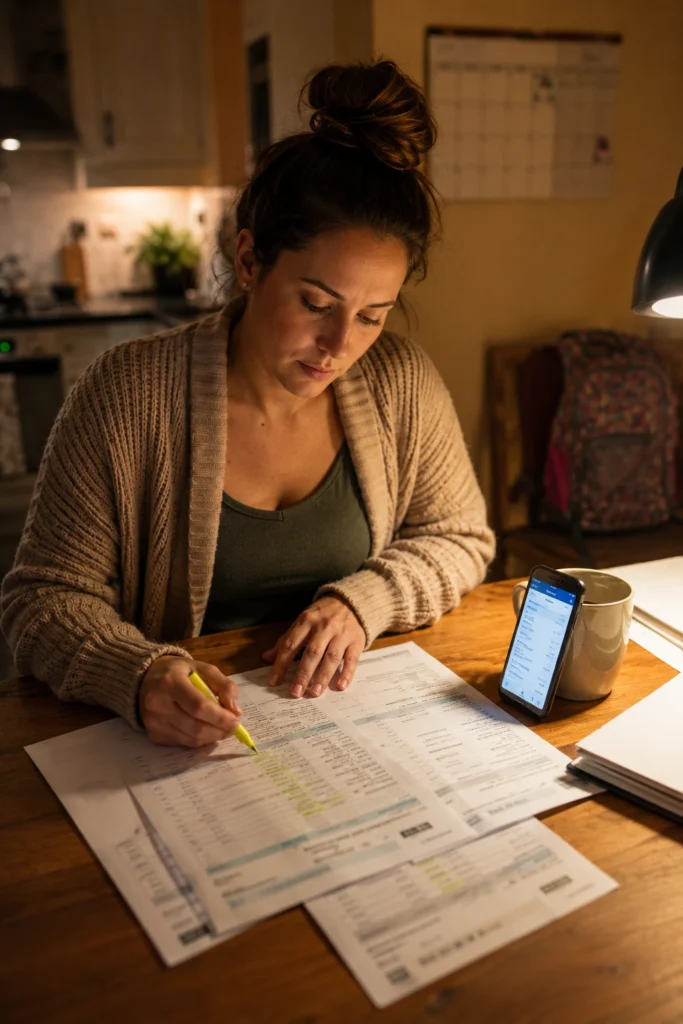
In week two only, pull the last three months of bank statements and go through every single transaction with a highlighter. Not what you think you spent. What actually left the account.
I did this myself years ago, pulling three months of statements from a period where money was disappearing somewhere I couldn’t identify, and found a slow drain of over three hundred dollars a month in charges I had genuinely stopped noticing. The categories that matter are the recurring charges running quietly in the background, the subscription set up during a free trial that converted to paid, the membership charged annually rather than monthly, the service upgraded once and never reviewed. Write every recurring charge down. Apply the “used in the last thirty days” test to each one. Cancel every service that fails it. Add the recovered monthly amount to the automatic weekly transfer before the next billing cycle arrives.
Move Four: Target the Food Budget in Weeks Three and Four
Food is the most accessible single-lever spending category in a single-mom household, because it combines a genuinely necessary expense with meaningful room for how that expense is managed. The gap between a food budget running on autopilot and one that’s actively managed for a month is often larger than people expect, without requiring dramatic changes to what the family actually eats.
Packing lunches from home four days a week instead of purchasing them. Building one week’s meals from what’s already in the pantry before shopping for anything new. Buying generic versions of staple items the family will actually use. Choosing one protein bought in bulk and building multiple meals from it through the week. None of these are difficult. Each one applied consistently over thirty days produces a food budget that’s notably lower than the previous month without anyone in the house noticing a significant change to what they’re eating.
Move Five: Find One Childcare-Compatible Income Addition in Weeks Five Through Eight
This is the move most single mom savings guides handle incorrectly, by listing ten general side hustle ideas without accounting for the childcare constraint. The only income addition that works for single mom savings is one that fits within an existing window of available time that doesn’t require additional paid childcare to access.
Remote and digital work is the most consistently accessible category here. Content writing, virtual assistance, transcription, data entry, online tutoring during school hours, survey work during nap times, these can be done during windows that already exist in the schedule without triggering the childcare cost that in-person additional work would require.
Four to six hours per week at even a modest hourly rate, applied consistently across eight weeks, produces a meaningful additional contribution to the savings target. The goal isn’t finding the highest-paying option. It’s finding the one option that actually fits this week’s schedule and starting it rather than continuing to research alternatives.
Move Six: Sell Five Things in Weeks Five Through Eight
Most single-mom households have $200 to $400 worth of unused items in closets, storage, kids’ old gear, electronics replaced but not sold, clothing outgrown but not cleared out. Online selling platforms for each of these categories allow listing and selling without leaving the house. Every payment from these sales goes directly into the savings account on arrival.
Five items at an average of forty to sixty dollars each produces a one-time addition of $200 to $300 that doesn’t require ongoing time commitment beyond the initial listing effort.
Move Seven: Apply Any Windfall Directly on Arrival
A tax refund, a child tax credit disbursement, a work bonus, a cash gift, any money arriving outside the regular paycheck structure goes directly into the single mom savings account before it touches checking. Not half of it. Not what seems reasonable. The amount needed to close the gap to $1,000, whatever that remaining amount is at the moment the windfall arrives, deposited immediately.
This single rule can close the remaining distance to the goal weeks earlier than the baseline weekly contributions alone would, and it requires no additional behavior change beyond having the savings account open and ready to receive the deposit.
The Real Single Mom Savings Numbers Week by Week
Here is what single mom savings looks like when all seven moves are running simultaneously, broken into weekly and monthly contribution amounts.
| Source | Weekly Amount | Monthly Amount |
|---|---|---|
| Automated transfer (baseline) | $25 | $100 |
| Cancelled subscriptions (2-3) | $11 | $45 |
| Food budget optimization | $28 | $115 |
| Remote income addition (4-6 hrs) | $22 | $90 |
| Sold items (spread over 8 weeks) | $25 | $38 |
| Combined weekly single mom savings | $111 | $388 |
At $388 a month, a single mom savings target of $1,000 is reachable in approximately eleven weeks, staying well within a ninety-day window even accounting for the weeks where one category produces less than expected.
This table is deliberately conservative. It doesn’t assume a high-paying income source or a dramatic lifestyle change. It assumes three cancelled subscriptions, four home-packed lunches per week, one small remote income source, and five sold items spread over eight weeks. Four modest, specific changes applied consistently rather than twenty difficult changes applied sporadically.
What Happens When a Tax Refund or Credit Arrives
For single-parent households who qualify for the Earned Income Tax Credit or the Child and Dependent Care Credit, the annual tax filing season can produce a meaningful lump-sum addition to the savings target. I am not a financial advisor and this is not financial advice. For your specific eligibility situation, talk to a qualified tax professional. General information about these credits is available at the IRS Earned Income Credit information page.
The single mom savings strategy that accounts for these credits plans for the refund before it arrives. A parent who knows a refund is likely arriving in February can have the savings account open and the deposit commitment made in December, so the money goes in before any spending plans form around it. A single tax refund deposited immediately into the savings account can close the remaining gap to $1,000 in one transaction during a phase when weekly contributions have already built a meaningful base.
Twice-yearly extra paychecks work the same way. For households paid biweekly, two months of the year produce a third paycheck rather than two. Treating this extra paycheck as pre-committed to the savings account before it arrives, rather than available for general spending, can add $200 to $400 to the single mom savings total in a single week.
The Hard Numbers Behind Why $1,000 Changes the Financial Equation
According to the Federal Reserve’s Report on the Economic Well-Being of US Households, a significant share of American adults report they would struggle to cover an unexpected expense of $400 or more using cash or its equivalent without borrowing or selling something. For single-parent households operating on a single income, that vulnerability is amplified by the absence of a second income to absorb an unplanned cost without immediately disrupting other obligations.
The $1,000 target sits at two and a half times that $400 threshold. A car repair, a medical copay, a school expense, an appliance failure, most of the real emergencies that arrive without warning in a single-mom household fall below $1,000. Once the savings account contains that amount, most of those emergencies become an inconvenience rather than a crisis. They cost the money in the account and require rebuilding the balance afterward, but they don’t require a credit card, and they don’t produce an interest-accruing balance that occupies the next six months of the budget.
The credit card alternative, running a $600 repair at a typical high-interest rate and making only minimum payments, produces a total cost several times the original expense over a multi-year payoff period. The $1,000 in a savings account earns rather than costs. Every month the emergency doesn’t happen, the balance grows slightly. The asymmetry between those two outcomes is the entire financial case for making single mom savings the first financial priority even before accelerating debt payments.

The Week-by-Week Single Mom Savings Calendar
This is the specific calendar mapped across twelve weeks. Each week has one primary focus rather than multiple simultaneous changes, because the cognitive load of managing everything at once is one of the main structural reasons single-mom savings attempts collapse before reaching the target.
Week One: Open the high-yield savings account at a separate online bank. Set up the first automatic weekly transfer for whatever amount won’t overdraft. That is the only task this week.
Week Two: Pull thirty days of bank statements. Go through every transaction. Identify all recurring charges. Cancel any service unused in the last thirty days. Add the recovered amount to the weekly automatic transfer starting this week.
Week Three: Meal plan for this week based on what’s already in the fridge and pantry. Buy only what’s on the list. Pack lunches for every workday this week. Track the actual grocery and food spending total at the end of the week and compare it to the previous week.
Week Four: Continue the packed lunches and the automatic transfer. This is the habit reinforcement week rather than the habit establishment week. The goal is for both practices to feel less unusual at the end of week four than they did at the beginning of week one.
Research one specific remote or digital income opportunity that fits within actual available hours. Write down the platform or contact method. Don’t start it yet.
Week Five: Start the income addition. Four to six hours this week. Every payment goes directly to the savings account on arrival. List the first two unused items for sale.
Week Six: Continue all three running sources: the automated transfer, the packed lunches, the income addition. List two more unused items. Check the savings account balance. For most single mom savings plans running this calendar, the balance at the end of week six sits somewhere between $300 and $450.
Weeks Seven and Eight: Continue all sources. List the fifth item for sale. If any windfall arrives this week (sold item payment, unexpected cash), it goes immediately into the savings account. Check the balance at the end of week eight.
Weeks Nine Through Twelve: Maintain everything running. Add any arriving windfall or tax-related income directly to savings. The final push is not about adding new levers. It’s about protecting the existing ones through to the finish line.
The Single Most Important Rule of the Final Three Weeks: Do not treat the savings account balance as available for any expense that isn’t a genuine emergency during this window. The finish line is close enough that one impulse withdrawal can push the timeline back by two to three weeks in a way that’s harder to recover from psychologically than financially. Protect the balance through week twelve and close out the single mom savings goal before touching it for any non-emergency purpose.

The Behavioral Layer: Why Single Moms Under Financial Stress Need Systems, Not More Willpower
Financial stress does specific things to decision-making that generic budgeting advice consistently fails to account for. Research on scarcity and cognitive bandwidth shows that sustained financial pressure narrows the available mental resources for good decision-making, making sound financial choices harder to make consistently precisely when the stakes of those decisions are highest.
This is not a character flaw and it is not unique to single moms. It is a documented behavioral pattern that affects people under persistent resource pressure across multiple contexts. Understanding it changes how the single mom savings method is designed, because reducing decision points is more effective than increasing motivation when cognitive bandwidth is already stretched thin.
The automatic transfer removes the savings decision entirely after week one. It just happens on schedule, before any competing decision gets a chance to engage with the money. The packed lunch is a batch decision made once on Sunday during a calmer moment rather than a fresh decision every weekday morning at 7am when the household is already in motion. The cancelled subscriptions remove future spending decisions from the equation entirely. Each of these structural changes reduces the number of times a good decision has to be made correctly under stress, which is precisely why they work better than motivational advice for a household where stress is a regular condition rather than an occasional one.
The 24-hour rule for non-essential purchases works in this context for the same structural reason. It doesn’t require willpower in the moment. It requires a procedural commitment applied consistently: anything non-essential over thirty dollars gets a one-day wait before purchase. Many of those purchases never happen after the wait. The ones that do happen after twenty-four hours tend to be genuine needs rather than stress-driven impulses, and even the stress-driven ones feel different when the decision happens during a less pressured moment than when they first appeared urgent.
For a single-mom household specifically, the 24-hour rule has an additional function: it creates a buffer between the moment a child sees something at a store and expresses strong preference for it and the moment a purchasing decision actually happens. That buffer, explained calmly and consistently, also models a healthy relationship with spending for the children in the household, a genuinely valuable secondary effect.
The visual savings tracker, a simple grid of small dollar amounts crossed off as contributions are made, works because it converts the abstract goal into visible concrete progress. For a household where financial wins are rare and tend to feel distant, seeing a grid that’s thirty percent full, then fifty percent, then seventy percent, produces a specific kind of forward momentum that makes the final weeks feel different from the early ones, because the remaining distance is shrinking toward a visible end rather than sitting at an unmovable number that hasn’t changed yet.
What Changes When the Balance Hits $1,000
The financial change is concrete and specific. The next unexpected expense, a car repair, a medical bill, a school fee that wasn’t planned for, goes to a bank account rather than a credit card. The cost stays flat. There’s no interest rate applied to it, no minimum payment that occupies the following six months of the budget, no slow accumulation of a balance that’s still present in December from something that broke in March.
The less concrete change is the one most single moms describe as the more significant one: the specific background anxiety of knowing that one bad week can trigger a cascade across multiple bills, the low-level awareness of financial fragility that most single parents carry somewhere below conscious attention, reduces noticeably. It doesn’t disappear at $1,000. But its character changes, from an imminent threat to a more manageable one, and that change in how daily life feels is real enough to be worth naming directly.
The behavioral change is what matters most for what comes next. A single mom savings habit completed to its first target produces evidence that didn’t exist before: evidence that saving is possible in this specific financial situation, with this specific income and these specific constraints, during a year that wasn’t particularly generous. That evidence changes what the next milestone feels like before it’s started, from a distant aspiration to an extension of something that has already been proven.
If you want to understand the full 50/30/20 budget framework that supports the savings habit once the emergency fund is established, the single mom budget guide on this site covers the complete budget structure designed specifically for single-income households where childcare and fixed costs already push the standard percentages past their generic recommendations.

The Honest Summary
Saving $1,000 fast as a broke single mom on a tight budget in 2026 is not the same problem as saving $1,000 from a position of greater financial flexibility, and any guide that doesn’t acknowledge that structural difference upfront is not written for this situation. The seven moves above are sequenced specifically for a household where childcare costs constrain income additions, where the budget is already running close to essential spending, and where cognitive load is a real resource that runs out before the month does. None of them require dramatic sacrifice. Every one of them is manageable within a week that’s already full.
Open the savings account tonight, before closing this tab, and set the first automatic transfer for whatever amount is actually there to send. That single action, a separate account and an automated transfer, is the real start of your single mom savings plan, and it takes less time than reading this paragraph. Everything else in this guide builds from that first step.