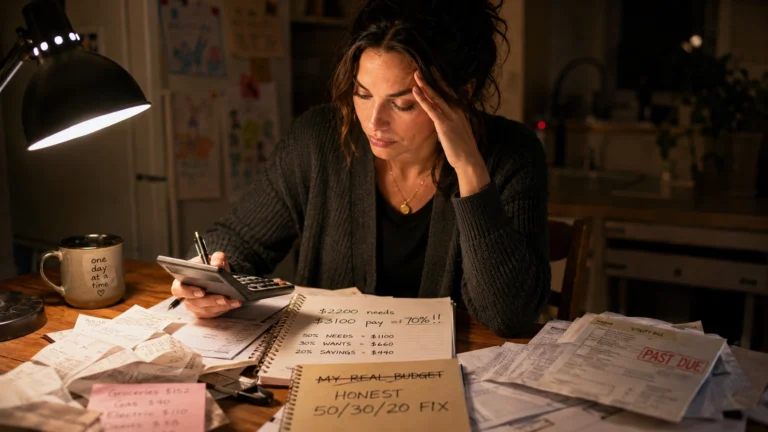

Nearly 40 percent of Americans couldn’t cover a surprise $400 expense without borrowing or selling something, according to Federal Reserve survey data. That statistic isn’t really about emergencies. It’s about how thin most budgets are stretched before anything unexpected even happens. Most of the budgeting mistakes single moms make aren’t dramatic financial decisions. They’re small, repeated blind spots that quietly compound until the whole plan stops holding up.
If you’re a single mom in the US juggling a full-time job, a household, and a budget that never quite behaves, you’re the reader this is written for. Going into 2026, the same handful of budgeting mistakes shows up again and again in reader questions and financial research. I’m Maya Collins, and I write about money for PennyToPower.com, where sourcing every claim actually matters to me. The research on this topic keeps circling back to the same ten habits, so that’s what this is about.
The budgeting mistakes single moms make most often fall into three categories: not having real numbers, ignoring irregular expenses, and treating savings as optional. Fixing even two or three of these can stop the monthly scramble. None of it requires more income, just a different order of operations.
What Most Budgets Get Wrong Before the Month Even Starts
Two mistakes show up before the budget is even written. The first is not having one at all. Plenty of people operate on a rough feeling for what they can afford, checking a bank balance instead of working from real numbers. That feeling doesn’t account for rent that’s due in nine days or the subscription that renews on the 3rd. It just tells you what’s true right now, which isn’t the same as knowing what’s coming.
The second mistake is close behind: guessing at your own spending instead of pulling real numbers. If you assume you spend $400 a month on groceries but you actually spend $600, the budget was never going to work, no matter how disciplined you are in week one. This isn’t a willpower problem. It’s a data problem, and it has a name: optimism bias. Consumer research published in the Journal of Consumer Research suggests people routinely underestimate their own discretionary spending by 20 to 30 percent. You’re not bad at budgeting. You’re working from a number that was wrong from the start.
Both mistakes fix the same way. Pull the last 90 days of bank statements and categorize every transaction, no editing, no rounding down. That number, the uncomfortable one, is your actual starting point.

The Budgeting Mistakes Single Moms Make With Money That’s Already Spoken For
Once real numbers are in place, the next set of budgeting mistakes single moms make involves money that technically exists but isn’t accounted for anywhere. Two habits sit here.
Forgetting irregular expenses. Rent and utilities get budgeted every month without fail. Car registration, holiday gifts, back-to-school costs, and annual insurance premiums don’t show up monthly, so they don’t get a line item, and then they land like a surprise every single time. A sinking fund solves this directly. A sinking fund is a savings category you fund gradually, ahead of time, for a cost you already know is coming. Add up every irregular cost for the year, divide by twelve, and move that amount into a separate account every month. A $1,200 total in annual costs becomes a $100 monthly transfer instead of a $1,200 shock. Investopedia has a clear breakdown of the mechanics if the concept is new to you.
Skipping the emergency fund. This is where that opening statistic becomes personal. Without a cushion, a car repair or a sick day without pay turns into a credit card balance. Start small. A single week of expenses, or $1,000, is a realistic first target, not three to six months of savings. That bigger number comes later, once the smaller one feels normal.
For a full breakdown of realistic emergency fund targets by starting point, this piece on emergency fund truths goes deeper than there’s room for here.
The Mistakes That Quietly Kill Saving Before It Starts
Savings mistakes are rarely about not wanting to save. They’re about where saving sits in the order of operations.
Putting savings last is the most common version of this. If saving only happens with whatever’s left at the end of the month, there’s usually nothing left. The fix, often called reverse budgeting, is to treat savings like a bill that gets paid the same day the paycheck lands, before anything else gets touched. Automating even 10 percent this way removes the decision entirely.
The opposite mistake is just as damaging: cutting out every bit of discretionary spending to save faster. It sounds disciplined. In practice, it tends to build resentment fast, the same way extreme restriction in dieting tends to end in a binge. A budget with zero room for a coffee or a small treat rarely survives a full month, let alone a year. A workable version of the 50/30/20 rule, generally 50 percent needs, 30 percent wants, and 20 percent savings and debt, works because it makes room for both.

The Hard Numbers Behind Why Budgets Break
Pulled together, the research on this topic breaks down into a few concrete figures worth sitting with:
- 40 percent of Americans couldn’t cover a $400 emergency without borrowing, per Federal Reserve data. This is the baseline problem an emergency fund solves.
- 20 to 30 percent is the general estimate for how much people underestimate their own discretionary spending, according to Journal of Consumer Research findings. This is why guessed budgets fail.
- A 10 to 15 percent buffer added to variable categories like groceries absorbs normal price swings without blowing the budget every time inflation ticks up.
- 10 to 20 percent of income, automated the day it arrives, is a commonly cited starting range for savings before lifestyle inflation eats the raise.
None of these numbers are about perfection. They’re starting points, and exact figures vary depending on income, city, and household size.
The Fixes That Actually Hold Up Long-Term
Out of everything covered, three habits do the most work. First, automate what you can. Bills on autopay avoid late fees, and automated savings transfers remove the daily decision of whether to save. Second, review the budget monthly, not obsessively, just enough to catch a category that’s quietly stopped matching reality. Third, audit subscriptions specifically. Small recurring charges are easy to miss precisely because they don’t require a decision each month, and they’re often the fastest category to trim without giving up anything that actually matters to you.
A budget built on real numbers, with irregular costs accounted for and savings automated first, tends to survive contact with an actual month. That’s a low bar, and it’s also the bar most budgets never clear.

Where To Start This Week
Pick one mistake from this list, the one that felt most familiar, and fix only that one this week. Not all ten. One.
If it’s the guessing problem, pull 90 days of statements. If it’s the missing emergency fund, open a separate account and move $25 into it today. The budgeting mistakes single moms make aren’t a character flaw, and they don’t all need to be fixed at once. A budget that survives six months of real life beats a perfect one that survives three weeks.
People Also Ask
What’s the very first budgeting mistake to fix?
Start with real numbers, not motivation. Most budgeting mistakes single moms make trace back to guessed spending figures instead of actual ones. Pull 90 days of bank statements before changing anything else. Everything downstream, from category limits to savings goals, depends on that number being accurate rather than optimistic.
How much should I have saved before I start budgeting seriously?
Nothing, technically. You don’t need savings to start a budget, you need a budget to start saving. A realistic first target is $1,000 or one week of expenses, built gradually through automated transfers rather than saved all at once from willpower.
What is a sinking fund, in plain terms?
A sinking fund is money set aside gradually, ahead of time, for a cost you already know is coming, like car registration or holiday gifts. Instead of an annual expense feeling like a surprise, you divide the total by twelve and treat it as a small monthly transfer.
Is it okay to budget money for fun, or does that defeat the purpose?
It’s not just okay, it’s part of why budgets survive. Cutting out all discretionary spending tends to backfire within a few weeks. A small, planned “guilt-free” category, inside a framework like 50/30/20, keeps the plan sustainable instead of setting up a spending binge later.