

Somewhere between the hospital bill and the first month of daycare invoices, a lot of women hit the same quiet realization: the math doesn’t work the way it used to. Not because they made a mistake, and not because they suddenly got worse with money.
Feeling financially behind after baby is one of the most common experiences new mothers have, and almost nobody talks about it honestly, because it gets buried under the assumption that if the numbers feel wrong, the person must be doing something wrong.
That assumption is backwards. Being financially behind after baby isn’t a story about budgeting harder or cutting out coffee. It’s a real look at why the finances of new motherhood genuinely change, what the actual data says about how much they change and for whom, and what to do about it that doesn’t involve pretending the feeling isn’t real.
Feeling financially behind after baby happens because household income and expenses shift at the same time, in opposite directions, and most families are never told to expect it. Childcare costs rise sharply, one income often drops or disappears temporarily, and the psychological weight of providing for a child changes how every dollar feels, even when the actual numbers are manageable.
Why This Actually Happens, Not Just How It Feels
For most women, income and spending used to move in a predictable rhythm before a baby arrived. A paycheck came in, expenses went out, and even a tight month followed a pattern that was at least familiar. A baby breaks that rhythm almost immediately. Income can shrink, sometimes for weeks during unpaid leave, sometimes for years if childcare costs make returning to work barely worth it financially. Expenses climb at the same time, not gradually, but all at once: medical costs, baby gear, and childcare that often becomes one of the largest line items in the entire household budget within months of a return to work.
The Federal Reserve’s own national survey data shows financial well-being among most groups stayed roughly flat between 2022 and 2023, with parents living with children under 18 seeing the share reporting they were doing at least okay financially fall by five percentage points, a decline sharp enough to stand out against an otherwise steady national picture. That’s not a feeling. That’s a measurable, documented shift specific to households with kids.
The Hard Numbers: What Childcare Actually Costs
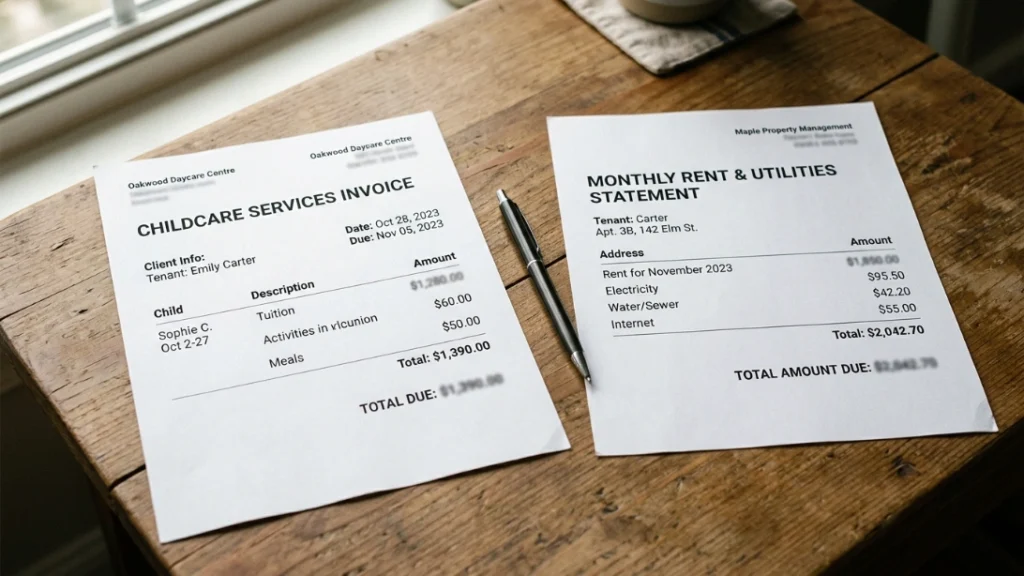
Childcare is a major driver of that shift, and the same survey quantifies it plainly. Parents who paid for childcare reported a median monthly cost of $800, rising to $1,100 a month for families paying for 20 or more hours of care each week. A more recent installment of the same survey found that just over half of parents using paid childcare spent at least 50 percent as much on childcare as they did on housing, historically the largest single expense in most household budgets. When a second-largest expense arrives on top of an already stretched budget, often within the same year income may have temporarily dropped, the sense of being financially behind isn’t confusion. It’s an accurate read of what actually happened.
Paid Leave Access Makes This Worse for Most Women
Part of why the financial shock feels so sudden is that most women simply don’t have paid leave to soften it. According to the Bureau of Labor Statistics, only 27 percent of private-industry employees had access to paid family leave through their employer as of March 2023, meaning the majority of new mothers face at least some portion of their leave completely unpaid. Access also varies sharply by income: BLS data shows workers in the lowest 10 percent of wages had access to paid family leave at a rate of just 6 percent, compared with 43 percent for workers in the highest 10 percent, meaning the women most likely to feel a severe income drop after birth are often the same women least likely to have any paid leave cushioning that drop in the first place.
This matters directly for anyone feeling financially behind after baby, because it reframes the timing of the financial hit. It isn’t spread evenly across the first year. For a large share of working mothers, the sharpest income disruption happens in the first several weeks, precisely when medical costs and newborn expenses are also at their highest, a genuinely brutal overlap that has nothing to do with how well anyone budgeted going in.
The Psychological Weight Nobody Warns You About
There’s also a psychological layer that pure numbers don’t capture. Before a baby, a tight month felt temporary, something to correct next paycheck. After a baby, every dollar carries a different weight, because it’s no longer just about your own comfort, it’s tied to a child’s needs, and that shift alone makes normal financial stress feel heavier and more urgent than it did before, even at an identical dollar amount.
Genuinely comparing your finances before and after a baby the wrong way makes this worse. Comparing this month’s bank balance to a pre-baby month isn’t a fair comparison, expenses and income both changed structurally, not just incrementally. A more honest comparison looks at whether your current income covers your current fixed costs with anything left for savings, not whether you have the same amount left over you used to.
Understanding why you feel financially behind after baby is also where the timeline matters more than most families expect. Recovery isn’t instant, and it isn’t supposed to be. Research on household finances around childbirth consistently shows a real dip in economic well-being in the months immediately surrounding a birth, followed by a gradual recovery as income stabilizes, childcare arrangements settle, and one-time costs, medical bills, baby gear, taper off. Expecting to feel financially “caught up” within the first few months is expecting something the data itself doesn’t support.
A Decent Income Doesn’t Cancel This Out
A decent household income doesn’t make anyone immune to feeling financially behind after baby either, which is often the most confusing part for women who feel like they shouldn’t be struggling. A two-income household with a solid combined salary can still feel the exact same squeeze, because childcare costs scale with income far less than most other expenses do.
A family earning well above the national median can still be paying a median childcare cost that eats a large share of one parent’s entire paycheck, which is precisely why so many women describe returning to work and feeling like they’re barely breaking even once childcare is subtracted from what they bring home.
A Worked Example: What the Numbers Actually Look Like
Generic advice rarely shows the actual math, so here’s a realistic, illustrative example using the sourced figures above rather than invented ones. Consider a household where one parent earns $55,000 a year and takes eight weeks of leave, four of them unpaid, a common scenario given that only about a quarter of private-sector workers have paid family leave at all. That’s roughly $4,200 in lost income during leave alone, before a single childcare bill arrives.
Once that parent returns to work and childcare begins, using the Federal Reserve’s median childcare cost of $800 a month, that’s another $9,600 a year, and for a family paying for 20 or more hours of care weekly at the higher median of $1,100 a month, that climbs to $13,200 annually. Stack the temporary leave-related loss on top of the new ongoing childcare cost, and a household can be absorbing well over $13,000 to $17,000 in combined temporary and new permanent costs within the first year, without anything having gone wrong financially. That’s not a budgeting failure. That’s the actual, calculable shape of what changed.
Running this same math with your own real numbers, your actual leave pay, your actual childcare quote, is far more useful than any generic percentage, since it turns the vague feeling of being behind into a specific, addressable number.
What Actually Helps
What actually helps anyone financially behind after baby isn’t a stricter budget in the traditional sense, it’s rebuilding the budget around the new numbers instead of measuring against the old ones. Start by listing your actual current fixed costs, including childcare at its real cost, not an estimate, alongside your actual current income, including any temporary reduction from leave or reduced hours.
That gap, the real one, based on real numbers, is what you’re actually working with, and it’s almost always smaller and more specific than the vague feeling of being behind that shows up at 2am. Rebuilding a full household budget around your real post-baby numbers is worth doing properly rather than estimating.

From there, the most useful next step is identifying which costs are temporary and which are permanent. Medical bills from the birth, one-time baby equipment purchases, and short-term reduced income during leave are temporary, they will resolve. Ongoing childcare costs and the adjusted household budget are the new permanent baseline you’re actually budgeting around going forward. Separating the two prevents a temporary financial dip from feeling like a permanent failure.
I am not a financial advisor and this is not financial advice. If your specific situation involves a significant income change, debt from medical costs, or a decision about returning to work versus adjusting your household budget long term, talk to a qualified professional who can look at your actual numbers.
A few concrete steps make the difference between staying stuck in the feeling and actually working through it. First, write down your real current numbers, not remembered ones, an actual current childcare bill, an actual current paycheck, an actual current list of fixed costs. Vague numbers keep the feeling vague too, and vague problems are much harder to solve than specific ones.
Second, separate the one-time costs from the ongoing ones on paper, literally two columns if that helps. Seeing a medical bill or a stroller purchase sitting in a column labeled “temporary” does something real psychologically, it stops that number from bleeding into your sense of your permanent financial situation.
Third, revisit the budget again at three months and six months postpartum rather than expecting it to be finished once. Income, childcare arrangements, and expenses are still settling during this window for most families, and a budget built in week two rarely reflects reality by month four.
Finally, resist comparing your situation to another family’s timeline, even a close friend’s. Two households with similar incomes can have completely different childcare costs, parental leave policies, and support systems, all of which change how quickly this resolves. Your own numbers, tracked honestly over your own timeline, are the only fair comparison that exists.
Talking About It With a Partner or Support System
For women parenting with a partner, this financial shift often becomes a source of quiet tension, not because either person is doing anything wrong, but because the person managing the day-to-day budget is usually the one who feels the shortfall most directly and personally, even when both partners’ incomes are affected.
A useful way to bring this up isn’t “we’re behind,” which tends to land as blame or crisis. It’s closer to “our costs changed by roughly this amount, and our income changed by roughly this amount, here’s the real gap.” Framing it around the specific numbers from the worked example above, rather than a general feeling, tends to keep the conversation productive rather than defensive, since both partners are looking at the same concrete numbers instead of two different emotional interpretations of the same vague worry.
For single mothers, or anyone without a partner to share this conversation with, the same reframing still helps, just directed inward. Writing the real numbers down, leave income lost, new childcare costs, one-time expenses, turns an overwhelming feeling into a specific, finite list, which is genuinely easier to problem-solve against than an open-ended sense of falling behind.
The math looks different again for households where one parent stops working temporarily rather than just taking a few weeks of leave, whether that’s an extended unpaid leave, a decision to stay home during infancy, or a job loss that coincided with the pregnancy. In this scenario, it isn’t a partial income dip for a few weeks, it’s a full income gap for months, sometimes longer, layered on top of the same rising expenses every new parent faces.
This version of feeling financially behind after baby tends to trigger a different kind of stress, less about a specific number and more about an open-ended timeline: when does the second income return, and does it return at the same level it left at. Women who take an extended break from paid work sometimes find that returning at the same salary or role isn’t guaranteed, which adds a layer of uncertainty on top of an already stretched budget.
There’s no way to give a universal number for how long this dip lasts, since it depends entirely on the specific career, industry, and individual circumstances involved, but naming the two separate stressors, the temporary income gap and the uncertainty of what happens when it ends, at least makes each one individually easier to plan around instead of treating them as one undefined weight.
Rebuilding After the Initial Shock
Once the first several months have passed and the shock of being financially behind after baby has settled into a new, stable routine, even if that routine is objectively tighter than before, the next real task is rebuilding whatever buffer got used up along the way. Many families draw down savings or lean on credit during the early months simply because the numbers above, leave income lost, new childcare costs, medical bills, arrive faster than a budget can adjust to absorb them.
Rebuilding doesn’t need to happen all at once, and treating it as an urgent catch-up project usually backfires, since it adds pressure on top of a family that’s already stretched. This is also exactly the kind of situation an emergency fund is meant to absorb, even a small one, rather than relying on credit for every unexpected cost during this window.
A more sustainable approach is picking one specific, modest rebuilding goal, replacing what was drawn from savings during leave, for instance, and giving it a realistic timeline measured in months, not weeks. This is also where separating temporary costs from the new permanent baseline, covered earlier, becomes useful again: rebuilding savings is really only necessary to cover the temporary costs that already happened, not an attempt to somehow return to a pre-baby budget that no longer reflects your household’s real, current shape.
The honest version of this entire topic is that feeling financially behind after baby isn’t a phase to rush through or a problem to solve overnight. It’s a real, documented, temporary financial adjustment with a genuine recovery curve behind it, and the families who come out the other side feeling stable again are almost always the ones who stopped comparing themselves to their old numbers and started working, patiently, from their real current ones instead.
It’s Not a Personal Failing
It’s also worth naming plainly that this isn’t a personal failing, and the data backs that up directly. If the Federal Reserve’s own national survey shows parents of young children experiencing a documented drop in financial well-being that other groups didn’t experience in the same year, the problem isn’t that you’re managing money worse than you did before. It’s that the actual financial conditions of new parenthood genuinely got harder, for a specific, temporary, well-documented set of reasons.
Feeling financially behind after baby doesn’t mean something has gone wrong with your money management. It means your household absorbed a real, measurable financial shift that most families are never warned about in advance, and the way out isn’t a stricter budget aimed at your old numbers, it’s an honest one built around your new ones. Give yourself the time the recovery curve actually takes, and measure progress against your real current numbers, not the ones from before everything changed.
People Also Ask
Is it normal to feel financially behind after having a baby?
Yes, and it’s backed by data, not just a common feeling. Federal Reserve survey data shows parents of children under 18 experienced a documented drop in financial well-being in years when other groups did not, meaning the shift is real and measurable, not a sign of personal financial mismanagement.
How long does it typically take to recover financially after having a baby?
There’s no single fixed timeline, since it depends on income changes, childcare costs, and how quickly one-time expenses like medical bills are paid off, but research consistently shows a real dip in the months immediately around a birth followed by a gradual recovery as those costs stabilize.
Why does childcare cost so much compared to other expenses?
Federal Reserve survey data shows many families paying for both childcare and housing spend at least half as much on childcare as on housing, historically the largest expense in most household budgets, which is why adding childcare on top of existing costs creates such a sharp, sudden shift in a family’s budget.
Can a two-income household still feel financially behind after a baby?
Yes, since childcare costs scale with a family’s needs far more than with income level, a well-paid two-income household can still see a significant share of one parent’s paycheck absorbed by childcare costs alone, creating the same squeeze a lower-income household experiences.
What’s the difference between temporary and permanent costs after having a baby?
Temporary costs include one-time medical bills, baby equipment, and reduced income during parental leave, all of which resolve over time. Permanent costs, primarily ongoing childcare, become the new baseline your household budget should be built around going forward.
Is there financial help available for anyone financially behind after baby specifically because of the childcare cost gap?
Some employers, and a smaller number of states, offer dependent care flexible spending accounts or direct childcare subsidies, though eligibility and amounts vary significantly. Checking with your employer’s benefits department and your state’s department of human services is the most direct way to find out what’s available in your specific situation.
Does having paid leave through an employer meaningfully change how financially behind a family feels after having a baby?
Yes, considerably. Bureau of Labor Statistics data shows access to paid family leave is far from universal and skews heavily toward higher earners, meaning families without it often face a sharper, more front-loaded financial hit in the first weeks after birth than families with paid leave coverage, even at similar income levels overall.