
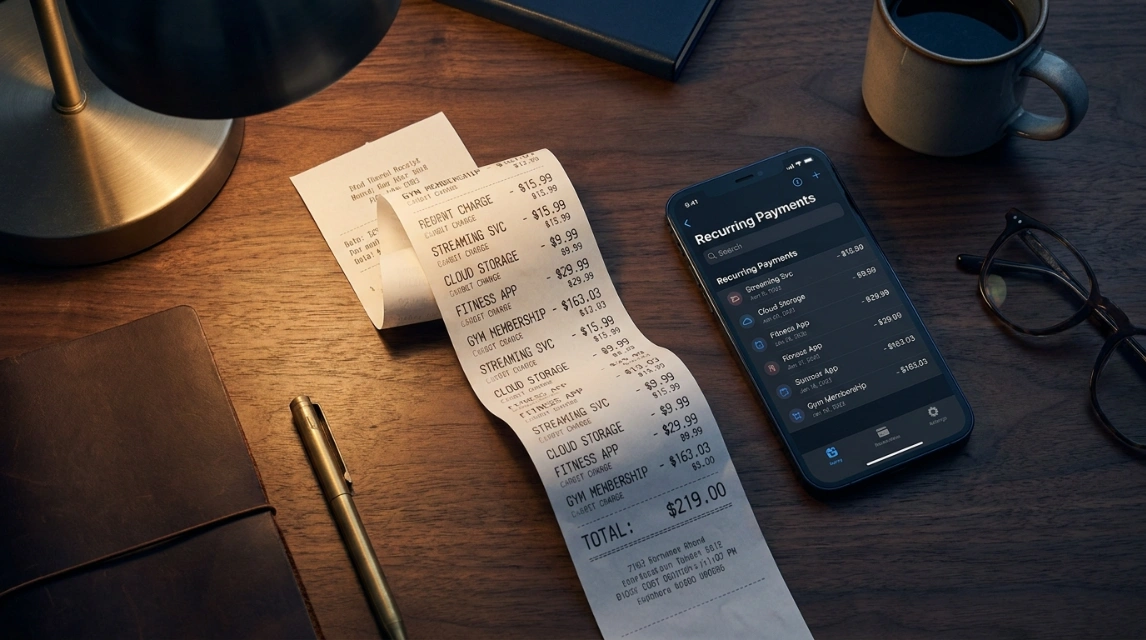
Hidden subscription costs in 2026 are running far higher than most households realize. Ask people what they spend on subscriptions each month and, per C+R Research, the average answer is $86. The same people, when they sit down and itemize every charge, land on $219 — a 2.5x gap between what’s believed and what’s actually leaving the account.
This isn’t a story about luxury add-ons or splurge purchases. It’s ordinary households losing track of ordinary recurring charges — streaming, cloud storage, apps, meal kits, fitness memberships — until the small numbers add up to something nobody would have agreed to in one lump sum.
The Real Numbers Behind Hidden Subscription Costs in 2026
A few figures make the scale concrete:
- $219/month is the average total, per C+R Research’s itemized survey — not a self-reported guess, but a category-by-category walkthrough that catches charges people tend to forget.
- 8.2 active subscriptions is roughly what the average household is juggling at any given time, across streaming, software, fitness, and delivery categories.
- 42% of people say they’ve kept paying for at least one subscription they’d already stopped using (CBS News).
- $204 a year, on average, is what those forgotten subscriptions alone cost — money spent on nothing at all.
- West Monroe’s independent research puts the number even higher, at $273/month, up from $237 when they first measured it in 2018 — different methodology, same direction: this kind of spending is climbing faster than awareness of it.
It’s worth being upfront that C+R Research and West Monroe don’t land on an identical dollar figure. What they agree on is the shape of the problem: most people are underestimating, and the gap is large enough to change a household budget.
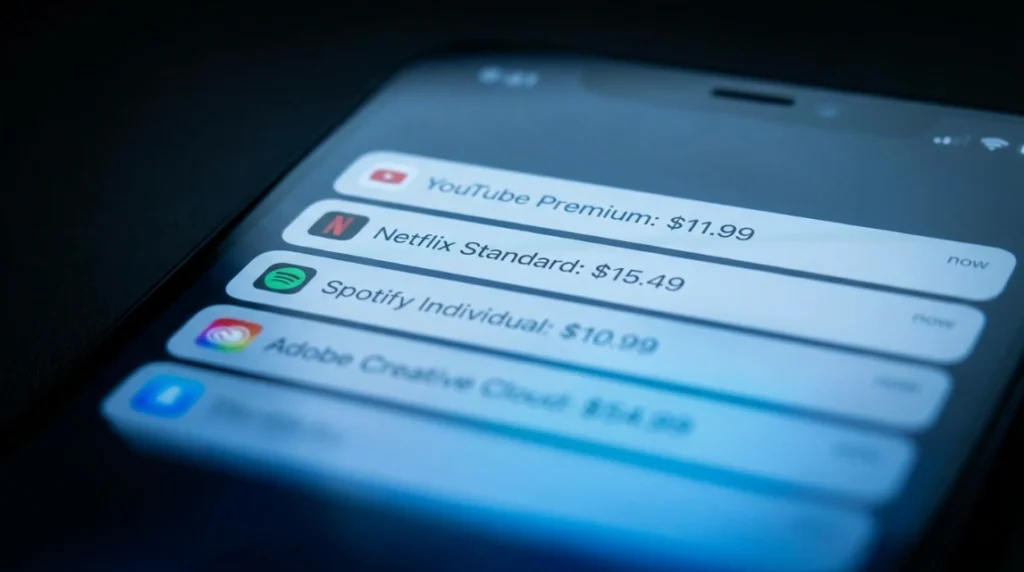
It Scales With Age, and Not the Way You’d Guess
The perception gap isn’t evenly distributed across generations (NGPF):
- Gen Z: roughly $377/month
- Millennials: roughly $276/month
- Gen X: roughly $167/month
- Boomers: roughly $87/month
Younger households — the group typically assumed to be the most digitally savvy — actually carry the heaviest subscription load. More apps, more platforms, more free trials quietly converting into paid plans. Convenience compounds quietly, and it compounds fastest exactly where people feel most in control of their spending.
Where the Money Actually Goes
Subscription spending isn’t concentrated in one category — it’s spread thin across several, which is part of why it’s so easy to lose track of:
Streaming video remains the most visible category. Deloitte’s 2025 Digital Media Trends survey found the average household pays for four streaming services at a combined $69 a month, a 13% increase year over year. That’s before accounting for music streaming, which usually runs as a separate line item entirely.
Software and productivity tools have quietly become a second major category, as everything from photo editing to note-taking has shifted from a one-time purchase to a recurring plan.
Fitness and wellness apps are a common source of forgotten charges specifically, since gym and workout-app subscriptions are often started with genuine intent and then abandoned without cancellation.
Cloud storage and small utility subscriptions — a few dollars here, a few dollars there — are individually painless and collectively significant once eight or nine of them are running at once.

Why This Kind of Spending Goes Unnoticed
Three habits keep hidden subscription costs invisible in the moment:
Fragmented billing. One charge hits a credit card, another goes through a phone’s app store, another renews once a year through a completely different account. No single statement shows the full picture.
Small numbers, big totals. A $7.99 plan doesn’t register as a meaningful budget item. Eight or nine of them do — which is roughly what the average household is now carrying at once.
Auto-renewal by design. Free trials are structured to convert automatically into paid plans unless a customer actively cancels — a pattern regulators have spent years trying to rein in, with mixed results so far.
The Legal Picture Is More Complicated Than Most Articles Admit
Many subscription-audit articles casually mention that the FTC now requires companies to make cancellation “as easy as sign-up.” That’s no longer accurate, and it’s worth getting right.
The FTC finalized its “Click-to-Cancel” update to the 1973 Negative Option Rule in October 2024, aiming to require that cancelling a subscription take no more steps than starting one. But on July 8, 2025 — days before the rule’s effective date — the U.S. Court of Appeals for the Eighth Circuit vacated the rule in its entirety, ruling that the FTC had skipped a required regulatory analysis and denied businesses a fair chance to weigh in during the rulemaking process. As of early 2026, the FTC has signaled it’s reviving efforts to revisit the Negative Option Rule, but no new federal rule has taken its place.
That doesn’t mean subscription cancellation is currently unregulated. The original 1973 Negative Option Rule is still in force, and the Restore Online Shoppers’ Confidence Act (ROSCA) already requires companies selling online to clearly disclose terms, get consent before charging, and provide a simple way to cancel — with real penalties for violations. Several states, including California, New York, and Minnesota, also have their own automatic-renewal laws that in some cases go further than the vacated federal rule ever would have.
The practical takeaway: don’t assume cancellation is legally guaranteed to be simple everywhere, and don’t be surprised if some services still make it deliberately difficult. The audit habit below matters regardless of what regulators eventually settle on.
How to Run the Audit in Your Own Budget
A subscription audit only works if it’s systematic, not just a quick glance at a bank app. Here’s the version that actually surfaces hidden subscription costs:
- Pull three months of statements, not one. Annual and quarterly charges won’t show up in a single month’s activity, and those are often the ones people forget entirely.
- List every recurring charge you find — streaming, software, memberships, deliveries, storage, apps — even the ones under $5. Small charges are exactly the ones that hide.
- Mark each one “active use,” “occasional use,” or “forgotten.” Be honest about the middle category; that’s usually where the leakage concentrates.
- Total the “forgotten” column first. That number alone is often the most persuasive argument for canceling something.
- Cancel or downgrade the forgotten and occasional tiers, then set a recurring quarterly reminder to repeat the process. This is a maintenance habit, not a one-time fix — new subscriptions and forgotten trials accumulate again within months.
- Consider a dedicated tracking tool if the manual process feels overwhelming. Services like Rocket Money — which reports more than 5 million members and charges $7 to $14 a month on a pay-what-you-want model — specialize in surfacing recurring charges automatically and can also negotiate lower rates on bills like cable and internet.
If you’ve already tackled the higher-ticket end of your recurring spending, our honest look at cutting luxury subscriptions is a useful next stop for bigger-line-item costs rather than the small, easy-to-miss ones covered here.
Frequently Asked Questions
How much does the average person actually spend on subscriptions in 2026? C+R Research’s itemized survey puts the figure at $219 a month, compared with a self-estimated $86 — a gap of roughly 2.5 times. West Monroe’s separate research estimates an even higher $273 a month.
Why do people underestimate their own subscription spending so badly? Mainly fragmented billing across cards and platforms, the small size of individual charges, and auto-renewal structures that don’t require any active decision to continue paying.
Is there a law that requires companies to make cancellation easy? Not currently at the federal level. The FTC’s 2024 Click-to-Cancel rule was vacated by the Eighth Circuit in July 2025 over a procedural error, though the underlying 1973 Negative Option Rule, ROSCA, and various state automatic-renewal laws still apply.
How often should I run a subscription audit? Quarterly is a reasonable cadence. New subscriptions, forgotten trials, and price increases tend to accumulate again within a few months of any cleanup.
The Bigger Point
Subscriptions aren’t a scam, and they aren’t inherently a bad deal — they’re a business model built on convenience, and convenience has genuine value. The problem is that most households have no accurate picture of their combined hidden subscription costs, and the businesses on the other end have very little incentive to make that picture clearer on their own.
Running the audit isn’t about cutting everything back to zero. It’s about closing the gap between $86 and $219, and deciding — with real numbers in front of you, rather than a guess — which parts of that gap are actually worth continuing to pay for.