The first of the month used to make me physically tense before I even opened my eyes.
Not because anything had gone wrong yet. Just because I knew what was coming. Rent. Car payment. Utilities. Insurance. All of them arriving within the same seven-day window, stacking against a paycheck that looked healthy on paper and collapsed the moment those charges hit. I had been managing money this way for three years, watching my balance swing from something resembling stability to something resembling panic, and telling myself this was just how adult finances worked. It is not. It is just how they work when nobody has shown you a better system. Learning how to split bills and save money changed the entire shape of my financial month, and it started with a method so simple that I felt genuinely embarrassed it had taken me so long to find it.
Most women in this situation share the same experience without realising how common it is. You earn a reasonable income, you are not reckless with money, and yet the first week of every month feels like a financial ambush. The problem is not your spending habits or your salary. The problem is a structural one, and structure is something you can actually fix.
Why the First of the Month Feels Like a Financial Ambush
The traditional bill payment cycle was not designed with modern income patterns in mind. Most major expenses, rent or mortgage, car payments, subscription services, and insurance premiums, are structured around the first of the month because that convention has existed for decades. Most salaries, however, arrive every two weeks, which means the timing between income and outgoing expenses is almost never perfectly aligned. You receive a paycheck on the fifteenth, spend through the rest of the month on daily expenses, and then face a wall of major bills the moment the calendar resets. Researchers who study financial stress patterns consistently find that this feast-and-famine cycle is one of the primary drivers of anxiety around money, not the absolute amount people earn.
What makes this worse is the psychological weight of watching a large sum disappear in a single week. Studies on financial behaviour show that lump-sum losses feel disproportionately painful compared to the same amount distributed across time. When $1,400 leaves your account in four days, it registers as a significant loss even if those payments were fully expected and planned for. Your brain is not being irrational. It is responding to the structure of the payment cycle, and that structure is something you can redesign.
The Half-Payment Method and Why It Works So Well
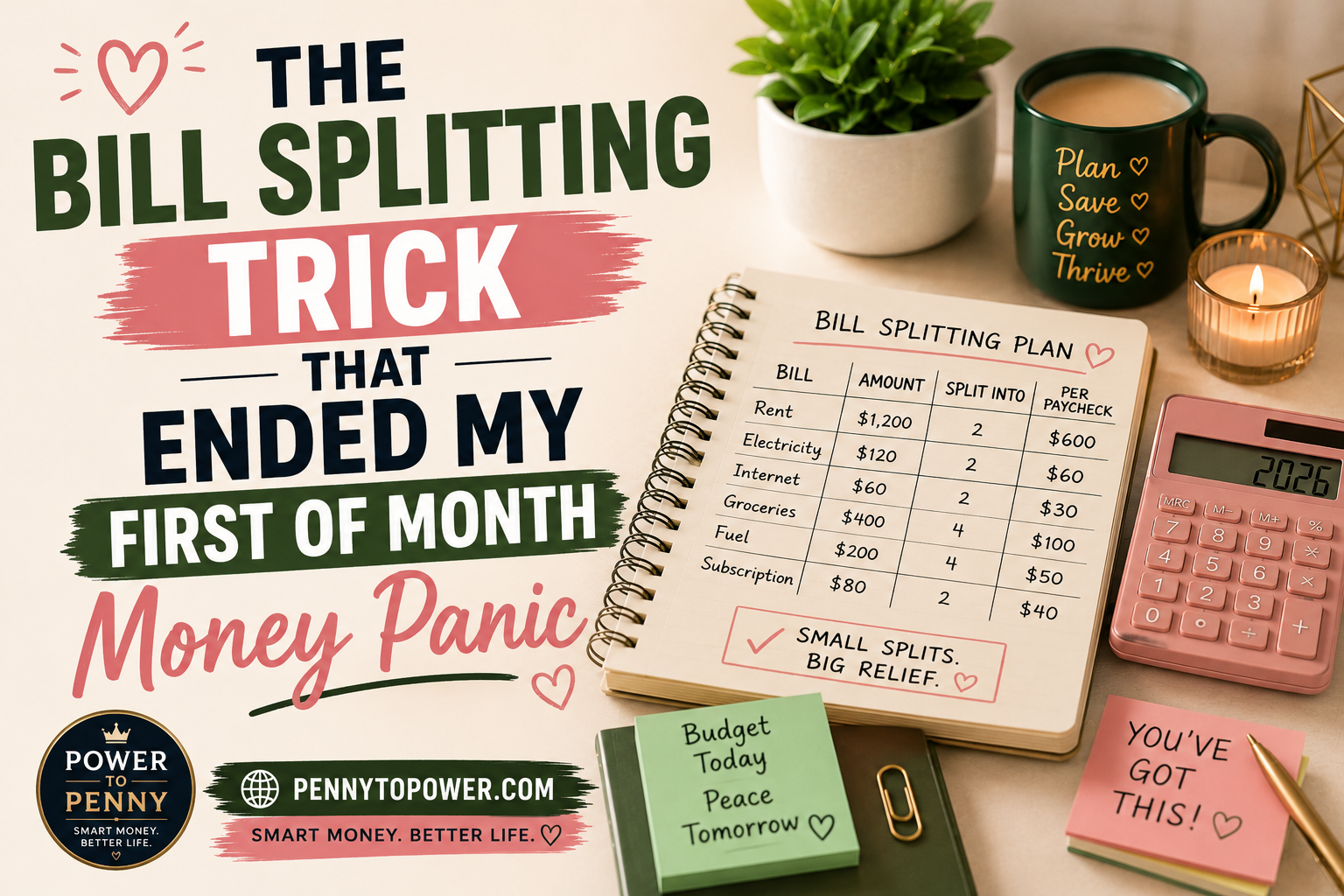
The half-payment method is the most practical approach to splitting bills and saving money from financial stress that I have ever applied in my own life. The core principle is straightforward: instead of paying each major bill in full when it arrives, you set aside half of every recurring payment during the paycheck before it is due, so the money is already waiting when the bill comes. You are not changing how much you pay or when the bill is officially due. You are changing when you mentally and practically account for the expense, which shifts the entire emotional and financial experience of bill season.
To see how this works in real terms, consider a monthly rent payment of $850. Under the traditional approach, you receive your paycheck on the first, rent comes out immediately, and you begin the month already feeling depleted. Under the half-payment method, you set aside $425 during your second-to-last paycheck of the previous month. When rent comes due, you only need to source the remaining $425 from your most recent paycheck, and the impact feels considerably smaller because it is. The same $850 goes out, but it leaves in two manageable portions rather than one destabilising chunk, and your opening balance on the first of the month looks entirely different.
How to Set Up the Half-Payment System Starting This Pay Period
Setting up this system requires one careful first month to build the initial reserve, and then it runs on its own momentum from that point forward. Begin by listing every major fixed expense you pay monthly, including rent or mortgage, car payment, insurance, loan repayments, and any subscription services above $30. Next to each amount, write half the total. These are the figures you will begin setting aside during the paycheck that arrives roughly two weeks before each bill is due.
Building the Initial Reserve Without Feeling the Pinch
The most common concern women raise about this method is the first month. If you are already stretched thin, finding an extra $425 in a single pay period to begin the reserve can feel impossible. There are two practical approaches that make this manageable. The first is to start with just one bill, your largest one, and build the half-payment habit for that single expense before extending it to others. The second is to treat your upcoming tax refund, any bonus, or a single month where expenses are lower than usual as the opportunity to build the initial reserve across all your major bills at once. Either approach works, and most women find that once the system is running for one or two bills, extending it to the full list feels natural rather than burdensome.
Using a Separate Account to Make the System Automatic
Keeping your half-payments in the same account as your daily spending is the fastest way to accidentally spend the reserve before the bill arrives. Opening a free secondary checking or savings account specifically for bill reserves takes about fifteen minutes at most banks, and the separation creates a psychological and practical boundary that makes the system significantly more reliable. The moment each paycheck clears, transfer the half-payment amounts immediately before you begin spending on anything else. Treat the transfer as a non-negotiable bill in itself, because in functional terms, that is exactly what it is.
Combining the Half-Payment Method with the Savings Stack
Learning how to split bills and save money works most powerfully when the half-payment method is paired with a parallel savings habit. Women who use both systems simultaneously report that the combination creates a compounding sense of financial control that neither approach produces alone. The half-payment method stabilises your monthly cash flow and eliminates the first-of-month panic. A consistent automated savings transfer, even one as small as $50 per paycheck, builds the cushion that protects you when unexpected expenses arrive.
The practical application looks like this. On payday, before any discretionary spending, you execute two transfers. The first goes to your bill reserve account to cover your half-payments. The second goes to your savings account as your consistent contribution. What remains in your primary account is your genuine spending money for the period, and you can use it without guilt because your obligations and your savings have already been handled. This sequence, obligations first, savings second, discretionary third, is the structural reversal that separates women who feel in control of their money from those who perpetually feel behind despite earning the same income.
What Changes When You Stop Living in First-of-Month Dread
The most immediate change most women notice is not financial at all. It is the absence of a particular kind of tension that had become so familiar they had stopped recognising it as stress. When the first of the month arrives and your rent reserve is already sitting in a separate account, the date loses its weight. The bills still go out. The amounts are the same. But the experience of paying them shifts from something that happens to you into something you have already handled. That shift is quiet, and it is significant in ways that are difficult to fully articulate until you have lived on both sides of it.
Over time, the half-payment method builds something that most financial advice skips over entirely: predictability. When your financial month has a reliable shape, you can begin to plan beyond immediate survival. You can identify which months have lower-than-average outgoings and direct the surplus intentionally. You can start funding the goals you have been postponing until things stabilise, because things have stabilised, because you built a system that makes stability possible rather than waiting for it to arrive on its own.
The One Decision That Changes How Your Month Feels
You do not need a larger salary to stop dreading the first of the month. You need a different structure for the salary you already have. The half-payment method is not a budgeting philosophy or a complicated financial strategy. It is a simple reordering of when money moves, and that reordering changes the emotional texture of your entire financial month in ways that compound over time. Women who implement this system consistently report that it is the single most practical change they have made to how they manage money, not because it involves any sophisticated financial knowledge, but because it addresses the structural problem that was causing the stress in the first place. If you want to learn how to split bills and save money without overhauling your entire financial life, this is where you start, and you can begin with your very next paycheck.