
Most women who open a crochet Etsy side hustle price their first blanket at whatever feels reasonable for a gift. A smaller group prices it like the small business it actually is, and that second group is the one still selling a year later.
If you’re sitting on a hook, a pile of yarn, and a folder of finished pieces you’ve been meaning to list, the gap between those two groups isn’t talent. It’s math. A crochet Etsy side hustle can genuinely bring in real income in 2026, but only if the pricing, the fee structure, and the time you’re actually spending get accounted for honestly before the first listing goes live.
[DIRECT ANSWER BLOCK] A crochet Etsy side hustle becomes profitable when your price covers materials, your real hourly time, and Etsy’s fees, not just the cost of yarn. Most new sellers underprice by 60 to 70 percent because they skip the labor line entirely. Building a sustainable crochet Etsy side hustle starts with the pricing formula below, not with the perfect first listing.
The Crochet Pricing Formula That Actually Covers Your Time
Here’s the math most new sellers skip, walked through step by step, using a mid-sized project as the example.
- Start with materials, doubled or tripled. If a project uses $25 in yarn and notions, multiply that by 2 to 3 to cover waste, mistakes, and packaging. That’s $50 to $75 before anything else is added.
- Add your actual labor. Track your real hours on a project, not a guess. Multiply that by a fair hourly rate, generally $15 to $25 an hour depending on your local cost of living and skill level. Eight hours at $20 an hour is $160.
- Add Etsy’s fees. Etsy charges a flat listing fee per item, plus a transaction fee on the total sale price (including shipping), plus a separate payment processing fee. Together these typically run in the neighborhood of 10 to 13 percent of your final sale price, so build that percentage in before you set the number, not after.
- Add a profit margin. After materials, labor, and fees are covered, add a margin on top, even a modest one, so the business can actually grow instead of just breaking even.
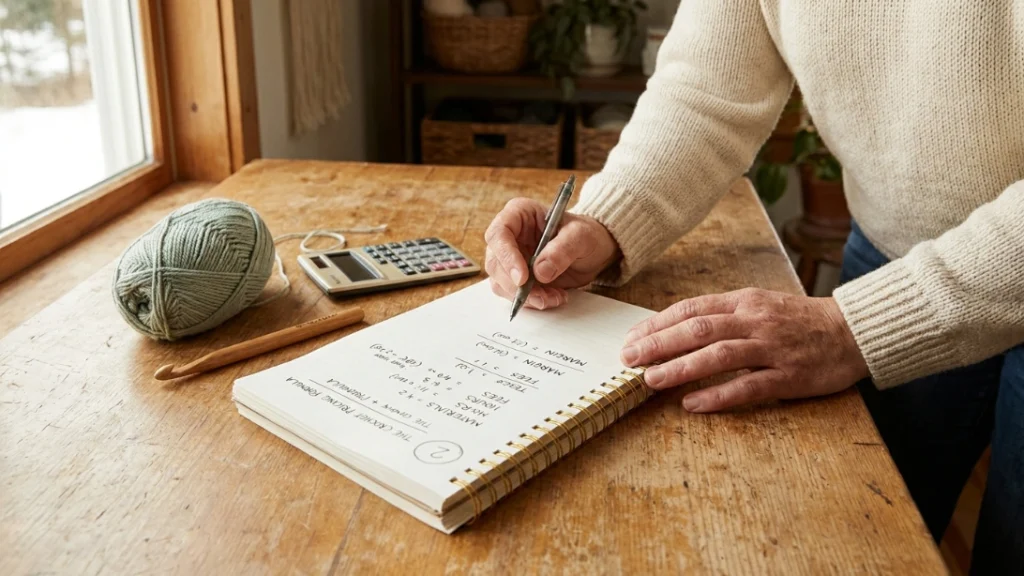
Run the math on a genuinely time-intensive piece, like an eight-hour baby blanket with $25 in materials, and the honest price lands closer to $200 to $250, not the $50 that “feels fair” for a handmade gift. That $50 price point isn’t generous. It’s a loss once your real hours are counted.
Why Your First Instinct on Pricing Is Almost Always Too Low
The most common mistake in a crochet Etsy side hustle isn’t a bad product. It’s a good product priced like a favor.
Most new sellers anchor their price to what a similar item costs at a big-box store, or to what feels comfortable to charge a friend. Neither number has anything to do with what the piece actually cost you in materials and hours. This is a version of a pattern that shows up across almost every side hustle: underpricing to avoid feeling greedy, then quietly burning out six months later when the math never worked in the first place.
The fix isn’t charging more just to charge more. It’s pricing from the formula above, every time, even when it feels uncomfortable the first few listings. According to the U.S. Small Business Administration, consistent, sustainable pricing is one of the most common factors separating small businesses that survive their first two years from those that don’t, and a crochet Etsy side hustle is a small business the moment money changes hands, not a hobby with a checkout button.
Choosing a Product Line That’s Actually Worth Your Hours
Not every crochet item has the same hourly payoff, and matching your product line to your available time matters as much as the pricing formula itself.
Small, fast-turnaround items like baby beanies, headbands, or coasters take under two hours each and work well if you’re selling in volume or bundling multiple pieces into a gift set to raise your average order value. Larger pieces like blankets or cardigans take far longer but can support a much higher price point per hour of work if priced correctly from the start. Digital crochet patterns are the one category that breaks the time-for-money trade entirely: you write and test a pattern once, then sell it repeatedly with very little added labor per sale, which is worth considering if you enjoy the design side as much as the stitching itself.
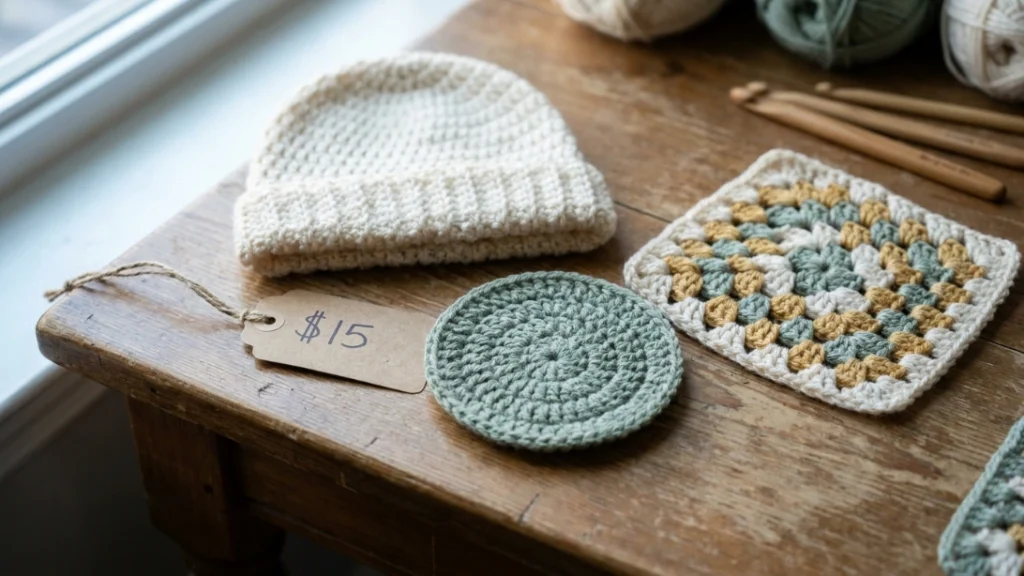
A practical middle path many sellers land on is selling partially finished components, like a set of individual granny squares for a buyer to assemble themselves. It gives a DIY buyer the satisfaction of finishing the piece while cutting your own most time-consuming step out of the equation.
What Actually Sells: Choosing Your Niche
A crochet Etsy side hustle that tries to make everything for everyone tends to struggle more than one built around a specific, focused niche.
Baby and children’s items, particularly small pieces like beanies and booties, stay in consistent year-round demand thanks to gift-giving and baby showers. Simple, recognizable stuffed animals and amigurumi pieces also perform well, especially when offered as custom commissions matched to a customer’s own pet or child. Home decor pieces like plant hangers, coasters, and storage baskets ride the broader home-styling trend, and simple wearable accessories, headbands especially, tend to be fast to make and reliable sellers, though clothing items in general are seasonal and peak heavily in autumn and winter.
Photography That Sells Without Feeling Fake
Buyers can’t touch a crochet item before buying it, so your photos are doing the job your hands would normally do in person.
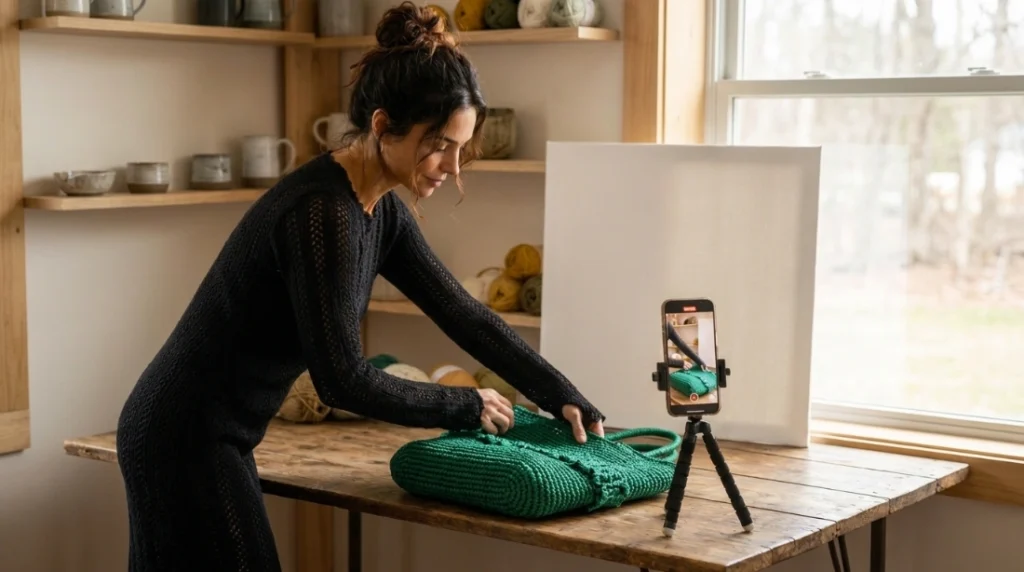
Photograph pieces near natural window light rather than under artificial lighting, and keep backgrounds simple: a plain wall, a wooden table, or a neutral blanket works better than a cluttered scene. Include a clear main photo, one close-up on the stitch detail, one shot showing scale (a hand or a common object for reference), and one lifestyle shot showing the piece actually being worn or used. Buyers on Etsy have grown noticeably wary of AI-generated product photos in the past year, since handmade shoppers specifically value visible, human-made imperfection, and an overly polished, synthetic-looking photo can work against you rather than for you.
The Part of a Crochet Etsy Side Hustle Most Sellers Skip: Marketing
Etsy’s internal search sends real traffic, but relying on it alone leaves a meaningful share of potential sales on the table.
Sharing your process, your packaging, or a quick before-and-after of a finished piece on Pinterest or Instagram builds a following that follows you back to your shop directly, rather than competing for attention inside Etsy’s own search results. A modest launch discount in your first week or two can also help nudge hesitant early buyers into becoming your first reviews, which matter more for future search visibility than almost anything else in your first month. Responding to buyer questions quickly and handling any early complaint generously, with an update or a fix rather than a defensive reply, tends to matter more for long-term shop health than any single marketing tactic.
What a Realistic First Few Months Actually Looks Like
Exact income figures vary enormously depending on your niche, your hours available, your local market, and plain luck, and any specific dollar figure attached to a stranger’s shop online should be treated with real skepticism unless it comes with a verifiable source. What’s more useful than a headline number is a realistic shape: most new shops see slow, sometimes discouraging sales in the first one to two months, followed by a gradual climb once a handful of reviews are in place and a consistent posting rhythm on social media starts sending outside traffic. Treating the first quarter as market research and pricing-formula practice, rather than a test of whether the whole idea works, tends to keep sellers from quitting right before the slow climb turns upward.
I am not a financial advisor and this is not financial advice. For your specific situation, especially anything involving business registration or taxes on your Etsy income, talk to a qualified professional.
If a full Etsy shop still feels like a bigger leap than you’re ready for, our guide to starting an Etsy shop with no money walks through a smaller first step, and our roundup of best-selling Etsy items for beginners is worth a look before you finalize your niche.
People Also Ask
How much does it cost to start a crochet Etsy side hustle? Startup costs for a crochet Etsy side hustle are genuinely low compared to most small businesses. Etsy charges a small per-listing fee, typically around 20 cents per item, plus a percentage-based transaction fee on each sale. Your real cost is materials and your own time, not upfront overhead.
Is a crochet Etsy side hustle still worth starting in 2026? A crochet Etsy side hustle can still be worth starting in 2026 if it’s priced correctly from day one. The market has more competition than it did several years ago, but demand for handmade, non-AI-generated goods has become a genuine selling point rather than a disadvantage.
How do I price crochet items for Etsy? Price crochet items for Etsy using materials doubled or tripled, plus your real hours at a fair hourly rate, plus Etsy’s fees (roughly 10 to 13 percent of the sale price), plus a profit margin on top. Skipping the labor line is the single most common pricing mistake.
What sells best in a crochet Etsy shop? Baby items, simple amigurumi, and home decor pieces tend to sell most consistently in a crochet Etsy shop, along with digital crochet patterns for sellers who enjoy the design side. Matching your product to how much time you actually have each week matters as much as the item itself.
The One Number That Matters More Than the Rest
A crochet Etsy side hustle succeeds or fails on one line in the pricing formula: whether your hours are actually being paid, not just your materials. Every other decision, your niche, your photos, your marketing, works in service of that one number holding up.
Start there before you list a single item. Price the next piece using the full formula, even if the number feels too high at first, and let the market tell you if it’s wrong rather than talking yourself down before you’ve tried.